


Fisheries Science and Marine Conservation
Wild capture fisheries take about 80 million tonnes a year from the sea and feed billions of people, and more than a third of the assessed stocks are overfished. This unit explains how a population grows and how much of it can be taken, why the catch per boat can stay high while a stock collapses, what happened to the northern cod in 1992, what fishing does to food webs and seabeds, and what fully protected marine reserves give back. It ends with the Red List, the whaling moratorium, the vaquita, and the parts of a fishery that works.
Fishing is the last large-scale hunt of wild animals that humans still carry out, and it feeds more people than any other. Every year about 80 million tonnes of wild fish and invertebrates are taken from the sea, about half of the world’s assessed stocks are fished as hard as they can bear, and more than a third are fished harder than that. This unit explains how fisheries scientists count fish they cannot see, how much a population can give up without shrinking, what happened to the largest cod fishery in the world in 1992, what fishing does to the rest of the food web, and what the ocean gets back when a piece of it is left alone.
1 The world’s catch
The Food and Agriculture Organization of the United Nations (FAO), based in Rome, collects the catch statistics that its member states report and publishes them every two years in a report called The State of World Fisheries and Aquaculture. The edition of June 2026 gives the picture for the year 2024. The world’s fisheries and fish farms together produced 235 million tonnes, of which 195 million tonnes were aquatic animals and 40 million tonnes were algae. Capture fisheries, the catching of wild animals, delivered about 92 million tonnes, which is about 11 kilograms for every person on Earth, and this figure has moved between 86 and 94 million tonnes every year since the late 1980s. Aquaculture, the farming of fish, shellfish, and seaweed, produced 142 million tonnes and has grown almost every year for half a century. When the seaweed is left out and only the animals are counted, the farms overtook the wild catch in 2022, for the first time, with 94.4 million tonnes against 91.0 million tonnes, and the farmed share has kept growing since. Almost nine tenths of the wild catch is marine; the rest comes from rivers and lakes.
These tonnes matter to a large part of humanity. In 2021 aquatic foods supplied at least a fifth of the animal protein of 3.2 billion people, and in 2022 about 61.8 million people worked in fishing and fish farming, most of them in small-scale fisheries in Asia and Africa. The FAO also assesses the stocks. Of the more than 2,500 fish stocks it reviewed for the 2026 report, 62.4 per cent were fished within biologically sustainable limits in 2023 and 37.6 per cent were overfished, which means that fishing had pushed them below the size at which they produce their largest yield (Section 2 defines that size). The large, well-managed stocks are mostly in the healthy group, so by weight 72.6 per cent of the assessed landings came from sustainable stocks. Figure 1 shows how the marine catch grew and then stopped growing.
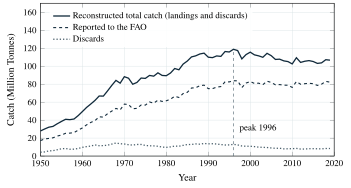
The reported figures are not the whole story, because a country reports what its statistical system sees. Fish caught by families for their own table, landed on beaches by small boats, taken illegally by foreign fleets, or thrown back dead because they are the wrong species or size are missing from most national returns. Daniel Pauly and Dirk Zeller spent a decade with a large network of collaborators rebuilding the catch of every maritime country from 1950 onward, sector by sector, from whatever records exist. This catch reconstruction concluded in 2016 that the true catch had peaked at about 130 million tonnes in 1996, against 86 million tonnes in the FAO statistics for that year, and that it had been falling by about 1.2 million tonnes a year since, mostly because the industrial catch was shrinking. The version of the database used for Figure 1 has been revised since the paper appeared and puts the 1996 peak near 119 million tonnes, which is still more than a third above the reported figure. The research spotlight below describes how the reconstruction was done.