A giant oceanic manta ray glides through blue water above a scuba diver, among small reef fish and rising bubbles.

Marine Biology Masterclass A 12-Week Online Program with Certificate

Study the life of the ocean one unit per week, with the published research of marine biologists working today.

  • Certificate
  • Online
  • Join a community of 3500+

Giant oceanic manta ray above a diver. Photograph: Daniel Sasse, CC BY-SA 4.0

Looking up through a forest of giant kelp, Macrocystis pyrifera, with sunlight coming through the canopy in gold and green.

Inside a forest of giant kelp, Macrocystis pyrifera. The stipes rise from the rocky bottom to a canopy that floats at the surface, and the sunlight that reaches the floor comes through it in gold and green.

Photograph: BravoGonzalo, CC BY-SA 4.0

Twelve weeks below the surface

The Marine Biology Masterclass takes you through life in the ocean one unit at a time. You enrol, and from then on a new unit reaches you every week. Each unit is a chapter written for this program, with worked examples based on real measurements, photographs and drawings of the organisms, and the published research of marine biologists who are active today.

A quiz completes every unit and opens the next. At the end you sit a final exam and receive an official certificate with a public verification page.

  • Structured. A fixed curriculum that starts with seawater and plankton and ends with the deep sea and the research done there now.
  • Demanding and fair. Real biology with the chemistry and the numbers behind it, explained step by step.
  • Recognized. An official certificate and transcript, both with a verification ID that anyone can check on this website.

How the program works

Read an excerpt

Read one complete unit before you enrol, exactly as participants receive it: the full text with its worked examples, figures, and research spotlight.

Glassy diatoms of many shapes under the microscope, lit blue against black: needles, discs, and a ladder-like chain.

Unit 3, 16 pages

Plankton and Primary Production

Diatoms that lived between the ice crystals of sea ice in McMurdo Sound, Antarctica, photographed through a microscope and digitized from a 35 mm slide. Diatoms are one of the four groups of phytoplankton that Unit 3 introduces, with dinoflagellates, coccolithophores, and cyanobacteria.

Photograph: Gordon T. Taylor, Stony Brook University, public domain

The phytoplankton of the ocean carry out close to half of all photosynthesis on Earth with less than one per cent of its photosynthetic biomass. This unit introduces the drifting life of the sea and the four groups of cells that do most of the work: diatoms, dinoflagellates, coccolithophores, and the cyanobacteria. It explains how light and nutrients set the limits of their growth, why the North Atlantic turns green each spring, and how primary production is measured from a bottle, a radioactive tracer, and a satellite.

The drifting algae and bacteria that feed the ocean and fix half of the carbon on Earth

Who is this program for?

High School Students

You want to understand life in the sea and get ahead in biology early. The masterclass prepares you for university applications in marine biology, biology, or environmental science, and for competitions such as the International Biology Olympiad (IBO), the National Ocean Sciences Bowl in the United States, and your national biology olympiad.

  • School biology and mathematics are enough
  • Certificate for applications
  • Ideas for a school research project

University Students

A supplement to a degree in biology, oceanography, or environmental science that widens your horizon. Use it to prepare for a field course, a dissertation, or a first research project at a marine station.

  • Worked examples with real data
  • Current research papers
  • Databases that researchers use

Lifelong Learners

You dive, keep a reef aquarium, or search rock pools at low tide, or you have always wanted to know what lives in the deep. The masterclass takes you through marine biology step by step.

  • No deadlines, pause any time
  • Unit 1 refreshes the basics
  • Read on screen or as PDF
Crew on the deck of NOAA Ship Pisces guide a CTD rosette over the side at sunset.

A CTD rosette goes over the side of NOAA Ship Pisces at sunset. The sensor at its centre records conductivity, from which salinity is calculated, temperature, and depth on the way down, and the bottles around it close at chosen depths to bring water back to the laboratory.

Photograph: NOAA Photo Library, public domain

How it works

  1. Enrol

    Create your account with your email address, choose your masterclass, and pay the Tuition Fee. Your program starts at once.

  2. Receive your unit

    Unit 1 arrives immediately and every further unit on a Monday, as a web page and as a PDF to keep.

  3. Study

    Work through the text, the worked examples, and the research spotlight, and answer the questions in the text as you go. A day later we send further reading, including research papers that are free to read.

  4. Take a quiz for every unit

    Each unit has its own quiz: ten questions, open book, no time limit. You submit it before the next unit is sent to you.

  5. Sit the final exam

    50 questions across all units of your masterclass in 60 minutes, open book. Pass with 70%, with up to 3 attempts.

  6. Earn your certificate

    Certificate and transcript as PDF, each with a verification ID and a personal link you can share.

The program in detail

Topics

16 units in three parts. Foundation covers Units 1 to 8, Advanced continues to Unit 12, and Advanced + Deep Sea adds Units 13 to 16.

A shallow coral reef at Palmyra Atoll in the central Pacific, pink and yellow-brown corals mirrored in the underside of the surface.

Pink and yellow-brown corals at Palmyra Atoll, a national wildlife refuge in the central equatorial Pacific, seen from just below the surface, which mirrors them. Coral reefs cover well under one per cent of the seafloor, yet roughly a quarter of all known marine species depend on them.

Photograph: Jim Maragos, U.S. Fish and Wildlife Service, CC BY 2.0

Units 1 to 8

Life in the Sea

What seawater, light, and pressure demand of living things, the plankton that feed the ocean, the invertebrates, fishes, and air-breathing animals of the sea, and the coastal habitats that shelter them.

  1. 1The Marine Biologist's Toolkit
  2. 2Seawater, Light, and Pressure
  3. 3Plankton and Primary Production
  4. 4Invertebrates of the Sea
  5. 5The Biology of Fishes
  6. 6Marine Mammals, Seabirds, and Sea Turtles
  7. 7Shores, Mangroves, and Seagrass Meadows
  8. 8The Ocean as a Living System
A humpback whale calf swims towards the camera in deep blue water off Hawaii, its mother close behind.

A humpback whale mother and her calf in the Hawaiian Islands Humpback Whale National Marine Sanctuary. Humpbacks travel to these waters from Alaska each year to mate and give birth, and February is the peak of the season.

Photograph: National Marine Sanctuaries, NOAA, public domain

Units 9 to 12

Reefs, Microbes, and Migrations

The microbes that run the ocean's nutrient cycles, how coral reefs are built and why they bleach, how whales, tuna, and turtles cross ocean basins, and how fish stocks are assessed and protected.

  1. 9Marine Microbes and Nutrient Cycles
  2. 10Coral Reef Biology
  3. 11Migration, Navigation, and Animal Tracking
  4. 12Fisheries Science and Marine Conservation
A pale dumbo octopus, Grimpoteuthis, with ear-like fins and coiled arms in black water.

Units 13 to 16, in Advanced + Deep Sea

The Deep Sea

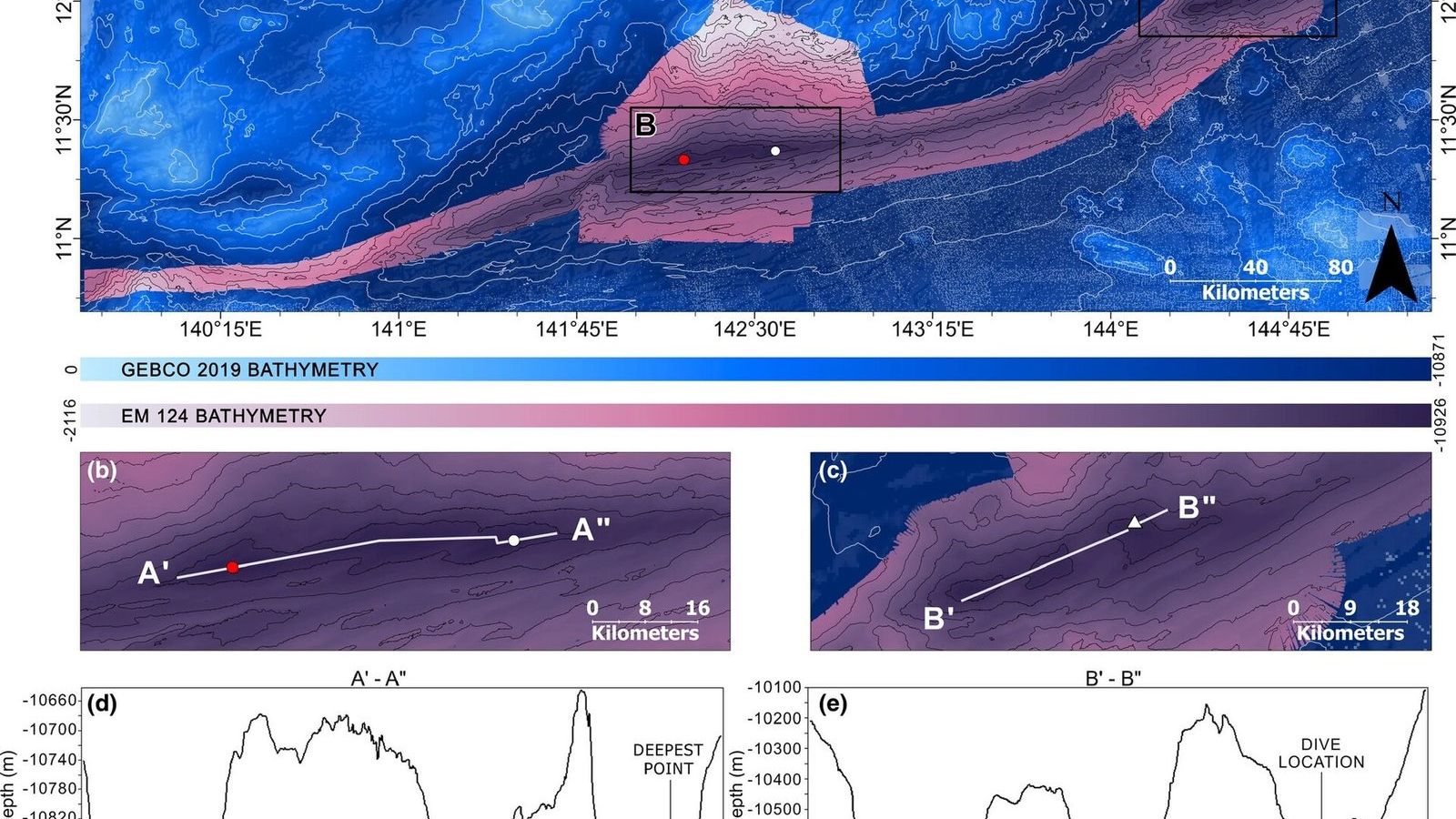
Animals that make their own light, life on volcanic vents without sunlight, the trenches more than 10 kilometres deep, and the robots and genetic methods that explore them.

  1. 13The Twilight Zone and Bioluminescence
  2. 14Hydrothermal Vents and Cold Seeps
  3. 15The Abyss and the Hadal Trenches
  4. 16Exploring and Protecting the Deep Sea

A dumbo octopus, Grimpoteuthis, swims off with its ear-like fins during a dive of NOAA Ship Okeanos Explorer. The coiled posture of its arms had not been observed in this species before.

Photograph: NOAA Okeanos Explorer, public domain

Full curriculum

Tuition Fee

Choose the masterclass that fits you. One Tuition Fee, paid once, covers all units, quizzes, the final exam, and your certificate.

8 weeks

Foundation

The fundamentals of marine biology: seawater, plankton, the animals of the sea, and the coasts.

Tuition Fee$35$39
Enrol in Foundation
  • 8 weekly units as web page and PDF
  • Quiz and further reading for every unit
  • Final exam, certificate, and transcript
16 weeks

Advanced + Deep Sea

The full program plus four units on the deep sea and its exploration.

Tuition Fee$85$119
Enrol in Advanced + Deep Sea
  • 16 weekly units as web page and PDF
  • Quiz and further reading for every unit
  • Final exam, certificate, and transcript

Tuition fees are one-time payments and include applicable taxes. Secure payment by card through Stripe, in US dollars, converted into your currency by your bank. Financial aid

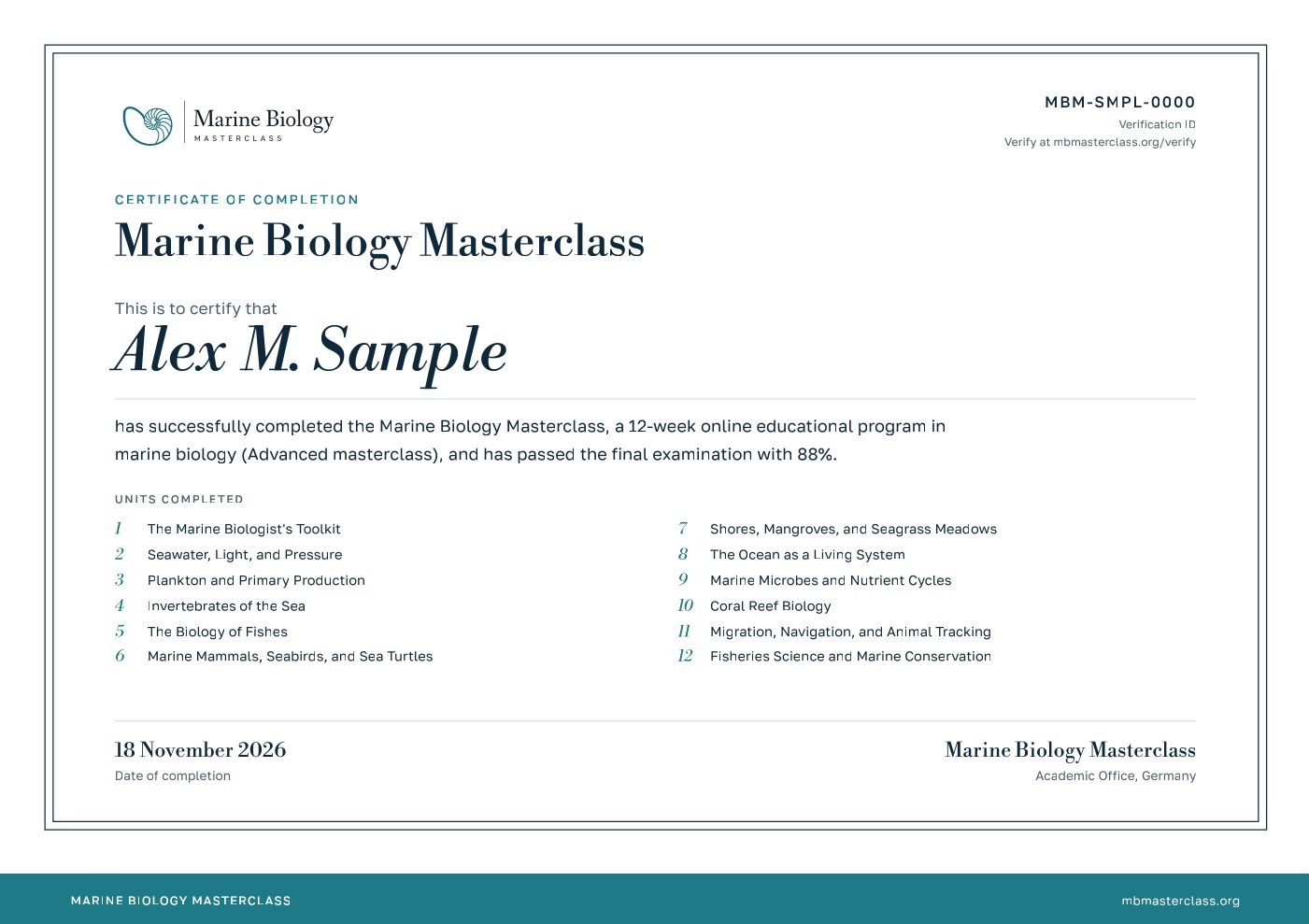
Sample certificate of completion of the Marine Biology Masterclass

Your certificate

Participants who pass the final exam receive an official certificate of completion. It states your name, the masterclass, its duration, and the units you completed.

  • Certificate and transcript. The transcript lists your score in every unit quiz and in the final exam.
  • Verifiable. Both documents carry a verification ID that can be checked on this website.
  • Shareable. Your personal verification link shows your result to universities, scholarship committees, and employers.
A reef shark swims low over the reef at Sipadan Island beneath a dense silver school of jacks.

Academic community

Masterclass participants come from all over the world, and when you complete the program you stay part of a network that keeps you close to the ocean and to the people who study it.

Ocean academics in our community
3500+
Countries represented
90+
Schools and universities represented
750+

A reef shark passes beneath a school of jacks over the reef at Sipadan Island, Malaysia. Photograph: Avoini, CC BY-SA 3.0

MB-Connect

Our alumni program introduces former participants to one another across countries: for study advice, exchange about university applications, and shared projects.

Opportunities

Past participants hear from us about scholarships, competitions, summer schools, and other academic opportunities in marine biology and ocean science.

A place in science

The program shows you how marine research is done and where it happens, at sea and in the laboratory, so that your next step at school, at university, or beyond is an informed one.

From the blog

All articles

Frequently asked questions

Who is this program for?

For high school students, university students, and lifelong learners. High school students use it to get ahead in biology early and to prepare for university applications or for competitions. University students in biology, oceanography, or environmental science take it next to their degree, before a field course or a first project at a marine station. Lifelong learners, among them many divers and aquarists, use it to understand what they see in the water. The Foundation masterclass suits a first contact with the subject; the Advanced masterclass goes on to marine microbes, coral reefs, animal migration, and fisheries.

What do I need to know before I start?

School biology and school mathematics are enough: cells, photosynthesis and respiration in outline, percentages, powers of ten, and simple equations. You do not need prior knowledge of marine biology. Unit 1 teaches every tool the later units use, including scientific names, logarithmic scales, exponential growth, and the methods of sampling at sea, and each calculation is shown step by step. From Unit 9 on, a derivative may appear inside a box marked as a mechanism in detail, with every step explained in words; the main text never depends on it.

How much time do I need each week, and are there live sessions?

Most participants spend three to five hours a week: two or three hours on the unit, under an hour on the open-book quiz, and the rest on the further reading if they want it. The program is fully online and has no live sessions, so it works in every time zone and next to school, university, or work. You receive the units by email and read them on the website or as PDF. Quizzes and the final exam are taken on the website.

Can I finish the program in less than 12 weeks?

Yes. A new unit is scheduled for every Monday, but once you have submitted the quiz of a unit you can ask for the next one ahead of schedule, from your dashboard or from the email we send you. The earliest moment is 24 hours after the previous unit was sent. We recommend the weekly rhythm, because the material needs time to settle, but the pace is your decision.

What happens if I fall behind or have to pause?

Nothing is lost. The next unit is only sent once you have submitted the quiz of the current one, so the program waits for you. You can pause for a week or for a term and continue at any time. There is no penalty and no deadline.

How does the final exam work?

After the last unit you sit the final exam online: 50 multiple-choice questions across all units of your masterclass, drawn individually for each participant, with a time limit of 60 minutes. It is open book. You pass with 70% correct answers. If you do not pass, you can try again after 3 days with new questions, up to 3 attempts in total.

All questions

California sea lions swim through turquoise water in the kelp forest off San Miguel Island.

Begin your 12 weeks in the ocean

California sea lions in the kelp forest off San Miguel Island, Channel Islands National Marine Sanctuary. Photograph: Claire Fackler, CINMS, NOAA, public domain