 Image: NMFS Northeast Fisheries Science Center (NOAA) (public domain)
How a blue whale's heart beats twice a minute
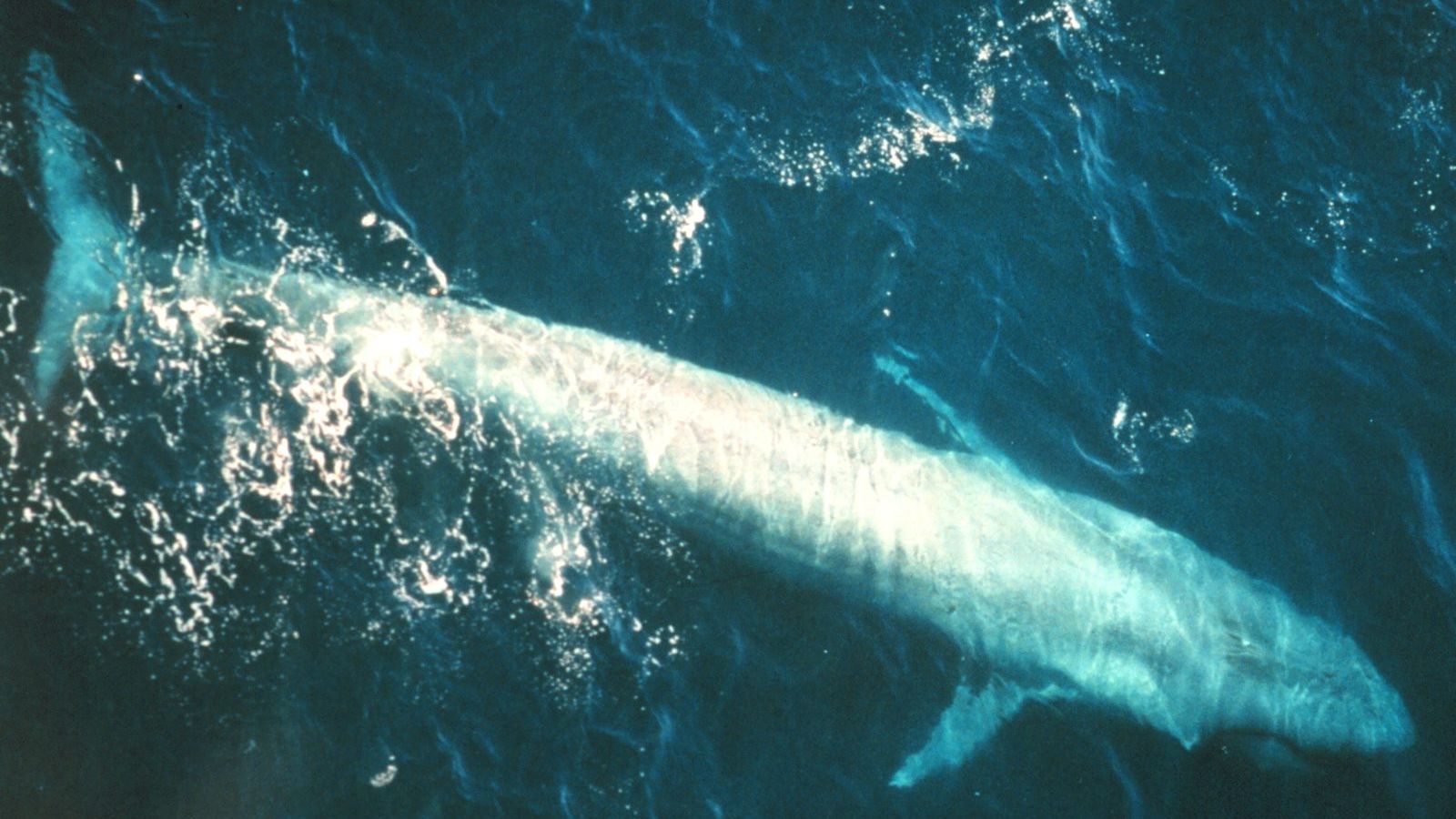
In 2018 a team from Stanford University's Hopkins Marine Station attached a tag with four suction cups to the back of a blue whale (Balaenoptera musculus) in Monterey Bay, California. Two of the cups carried electrodes. For nearly nine hours, through dozens of dives, the tag recorded the animal's electrocardiogram, the first ever taken from a free-swimming blue whale, and the trace showed a heart that slowed to as few as two beats a minute at depth and sped up to 25 to 37 beats a minute at the surface. Jeremy Goldbogen and his colleagues published the result in the Proceedings of the National Academy of Sciences in 2019, and it is the research spotlight of Unit 6 of the masterclass.
Why the heart slows
Every diving mammal does this, and so do you, in a small way, when you put your face in cold water. The dive response is a reflex that slows the heart, a bradycardia, and narrows the blood vessels to the muscles, the gut, and the skin, so that the oxygen in the blood is saved for the brain and the heart. Seals and whales do it on a scale no human can. A Weddell seal's heart rate can fall from 60 to under 10 beats a minute at the start of a dive, and the blue whale in Monterey Bay took the rate 30 to 50 per cent lower than the allometric prediction for an animal of its mass.
The physiological reason the rate can drop so far is that a whale's body is built to store oxygen outside its lungs. A human carries about 20 mL of oxygen per kilogram of body mass, most of it in the lungs. A Weddell seal (Leptonychotes weddellii) carries about 87 mL per kilogram, and most of it is in the blood and the muscle: the seal has twice the blood volume per kilogram of a human, with more haemoglobin in it, and its muscles are so rich in the oxygen-binding protein myoglobin that they are almost black. Whales are similar. The lungs of a deep diver are a small part of the store, and they are allowed to collapse under pressure, which is also why a whale does not get the bends.
A worked number
The aerobic dive limit is the time an animal can stay down before it has to switch to anaerobic metabolism, which produces lactate and needs a long recovery at the surface. In the simplest estimate it is the usable oxygen store divided by the rate of use. Take a 450 kg Weddell seal with 87 mL of oxygen per kilogram, which gives a store of about 39 litres. If the seal uses oxygen at about 2 litres a minute while diving, a rate that the dive response makes possible, the store lasts about 20 minutes. Gerald Kooyman measured the aerobic dive limit of Weddell seals directly in the 1980s, by sampling blood lactate after dives of known length under the Antarctic sea ice, and found about 20 minutes. Most of the seals' dives are shorter than that, which is the point.
The record holders stretch the arithmetic. In 2014 Gregory Schorr and colleagues reported satellite tag records from Cuvier's beaked whales (Ziphius cavirostris) off California that included a dive to 2,992 m and another lasting 137.5 minutes, the deepest and the longest recorded for any mammal. No simple store-divided-by-rate calculation gives two hours and a quarter without a metabolic rate far below anything measured at rest, and how the beaked whales do it is not settled.
What the blue whale's trace showed
The Monterey Bay whale dived to about 180 m for up to 16 minutes at a time, feeding on krill. At the bottom of each dive its heart ran at four to eight beats a minute, with the lowest readings at two. Each time it lunged at a krill swarm, mouth open, engulfing a volume of water close to its own body mass, the rate rose briefly by about two and a half times and then fell back, which shows the heart responding to the enormous effort of the lunge within a few beats. On surfacing the rate jumped to 25 to 37 beats a minute, the whale breathed hard for a few minutes, and then it dived again.
The surface rate is what caught the authors' attention. From the way heart rate scales with body mass across mammals, an animal of 100 tonnes should have a maximum heart rate somewhere near 30 to 40 beats a minute, and the blue whale's heart, a 180 kg organ with elastic arteries that keep the blood moving between its slow beats, is working at that ceiling after every dive just to repay the oxygen debt. There is no headroom left for a bigger body. The paper's conclusion is that the heart may be one of the things that sets the maximum size of an animal, and that the blue whale is at it.
Reading a dive profile
Tags like the one in Monterey Bay also record depth, and marine biologists plot a dive with the depth axis pointing down, so that the trace looks like the dive. A blue whale feeding on krill shows a saw-tooth of dives to a fairly constant depth with a short surface interval between them. A beaked whale shows a few very deep, very long dives with a series of shallow recovery dives after each one. A sperm whale's profile is somewhere between. Unit 6 of the masterclass plots a real profile from published tag data and asks what the animal was doing at each point, which turns out to be a question you can answer from the shape alone.
Where this leads
The dive response, the oxygen stores, and the aerobic dive limit are the three pieces that explain every diving animal from a cormorant to a sperm whale, and Unit 6 of the Marine Biology Masterclass builds them in that order, with the Weddell seal calculation above as a worked example and the blue whale electrocardiogram as its research spotlight. Unit 2 supplies the pressure and gas laws, including why a lung full of air at the surface is a fraction of its volume at 180 m. The full outline is in the curriculum.