Invertebrates of the Sea
Nearly every animal phylum lives in the sea, and most of them never left it. This unit follows the main groups of marine invertebrates along the animal tree, from sponges and jellyfish through worms, molluscs, and crustaceans to the echinoderms, and asks of each how it holds itself up, feeds, moves, and reproduces in water. Real measurements run through it: the water a sponge pumps in a day, the speed of a jellyfish sting, the filtering power of a mussel bed, the jet of a squid, the neurons of an octopus, and the distance a drifting larva travels.
The animal kingdom is divided into roughly 35 phyla, its great divisions, and nearly all of them have species in the sea, while about a third of them live nowhere else, whereas the vertebrates, which fill most of a zoology textbook, are one branch of one phylum. This unit is about the rest. It follows the main groups of marine invertebrates in the order in which they branch from the animal tree, from a sponge that pumps close to a tonne of water through its body in a day to an octopus that keeps most of its nervous system in its arms, and it asks the same four questions of each group: how the animal holds itself up, how it feeds, how it moves, and how it makes the next generation. The seawater of Unit 2 and the plankton of Unit 3 return on every page, because most of these animals eat plankton, and nearly all of them were plankton once.
1 The animal tree in the sea
1.1 The phyla and how they are related
A phylum is a group of animals that share one basic body plan, and the plan is usually visible at a glance: a sponge, a jellyfish, a snail, a crab, and a sea star are each built in a way that no other phylum repeats. Zoologists recognize about 35 phyla, and the number moves by one or two as small groups are merged or split. On 20 November 2026 the World Register of Marine Species, introduced in Unit 1, listed 215,057 accepted living species of marine animals. Four phyla account for about seven in ten of them:
- the arthropods (phylum Arthropoda, in the sea mostly crustaceans) with 60,322 marine species,
- the molluscs (phylum Mollusca) with 53,435,
- the chordates (phylum Chordata, the fishes and their relatives, which Units 5 and 6 cover) with 24,516, and
- the segmented worms (phylum Annelida) with 14,396.
About a dozen phyla have no species outside the sea at all, among them the echinoderms, the comb jellies, the arrow worms, the lamp shells, and the acorn worms, and only one small phylum of land animals, the velvet worms, has no living marine member, although its relatives of the Cambrian period, about 500 million years ago, lived in the sea.
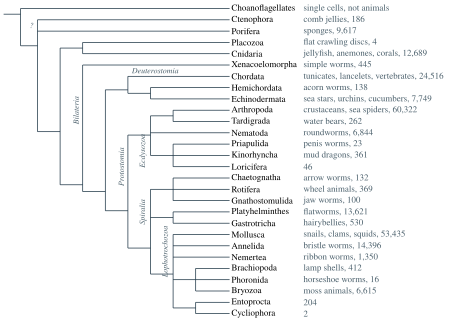
How the phyla are related to one another was argued about for 150 years on the basis of anatomy and embryos, and since the 1990s it has been read from genes. Figure 1 shows the current picture, drawn after the genome-scale study that the research spotlight below describes, and three divisions organize it. The Bilateria are the animals with a left and a right side, a front and a back, and they include every phylum from the flatworms upward. Within them, the deuterostomes (echinoderms, acorn worms, and chordates) are separated from the protostomes by what becomes of the first opening of the embryo. An early embryo is a hollow ball of cells that folds inward at one spot, and that dent is the embryo’s first opening; it becomes the anus in a deuterostome and, in the classical account, the mouth in a protostome, which is what the two names say, since they mean “second mouth” and “first mouth” in Greek. The names come from this nineteenth-century observation, and the genes have confirmed the two groups, even though the embryological rule itself turned out to have many exceptions among the protostomes.
The protostomes in turn fall into the Ecdysozoa, the animals that grow by shedding their outer skeleton (arthropods, nematodes, and several small phyla of worms), and the Spiralia, named after the spiral pattern in which their early embryo divides (molluscs, annelids, flatworms, lamp shells, moss animals, and others). Outside the Bilateria stand four phyla without a left and right side: the sponges, the comb jellies, the cnidarians, and the tiny flat placozoans. Whether the sponges or the comb jellies branched off first, and are therefore the living group most distantly related to all other animals, is the most discussed open question in animal phylogeny. For a century the sponges were the obvious answer, because they have no nerves and no muscles, and the simplest animal was assumed to be the oldest branch. Since 2008 many gene studies have put the comb jellies there instead, and a study of 2023 that compared the arrangement of genes along chromosomes came down on the side of the comb jellies. The tree in Figure 1 leaves the split open, as the spotlight paper does.