 Image: Craig Smith NOAA (public domain)
What a dead whale does for the deep sea
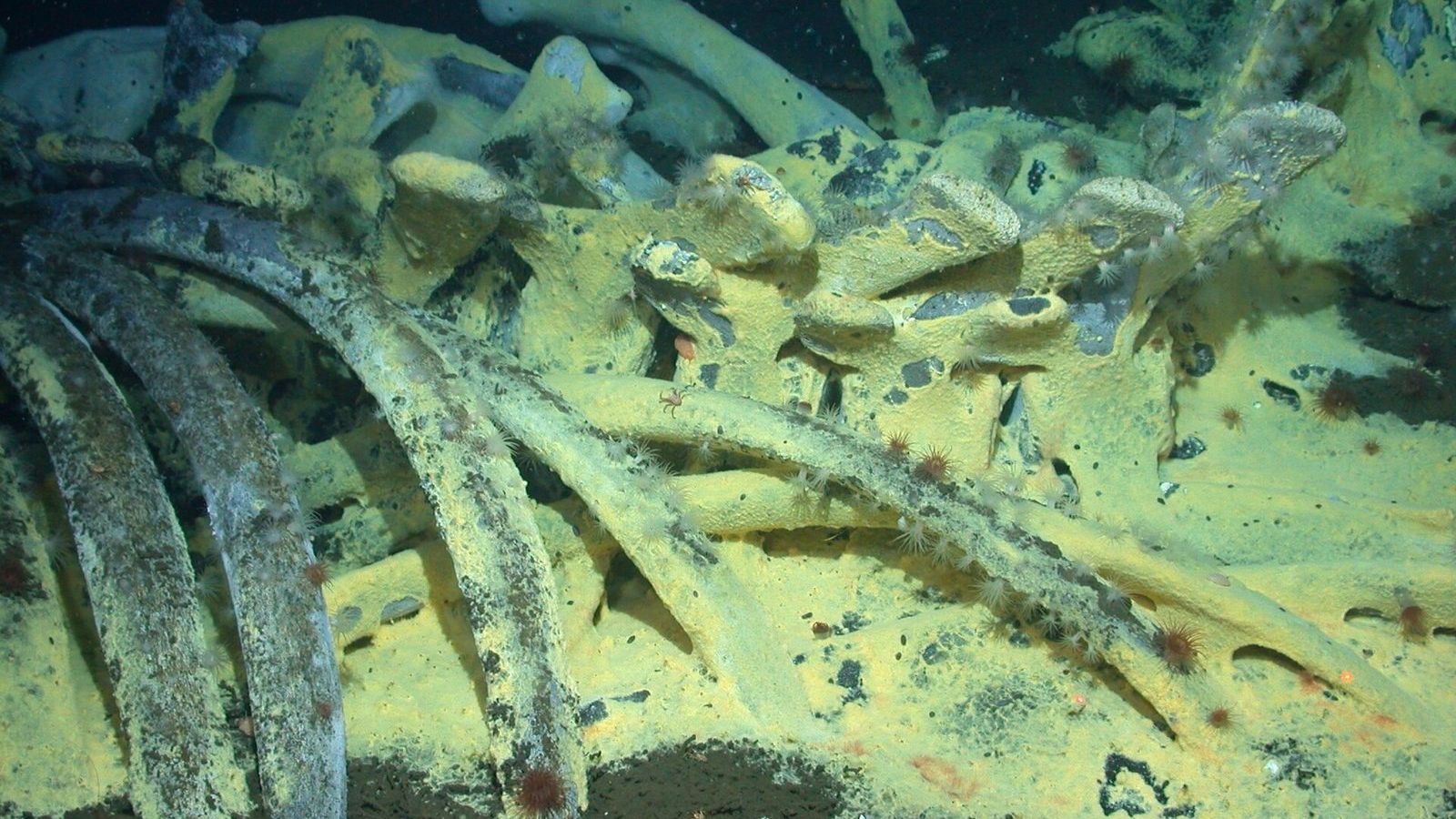
In February 2002 a remotely operated vehicle from the Monterey Bay Aquarium Research Institute came across the skeleton of a grey whale (Eschrichtius robustus) at 2,891 m in Monterey Canyon. The bones were covered in a red fuzz that turned out to be the plumes of thousands of worms, each a few centimetres long, rooted in the bone. They had no mouth and no gut. Inside the roots lived bacteria that digested the fats and collagen of the bone and fed the worm. The animals were a new genus, Osedax, the bone devourer, and they were described in Science in 2004 by Greg Rouse, Shana Goffredi, and Robert Vrijenhoek. Nobody had looked closely at a dead whale on the deep seafloor until the 1990s, and the first careful look produced an animal that no one had imagined.
Why a carcass matters down there
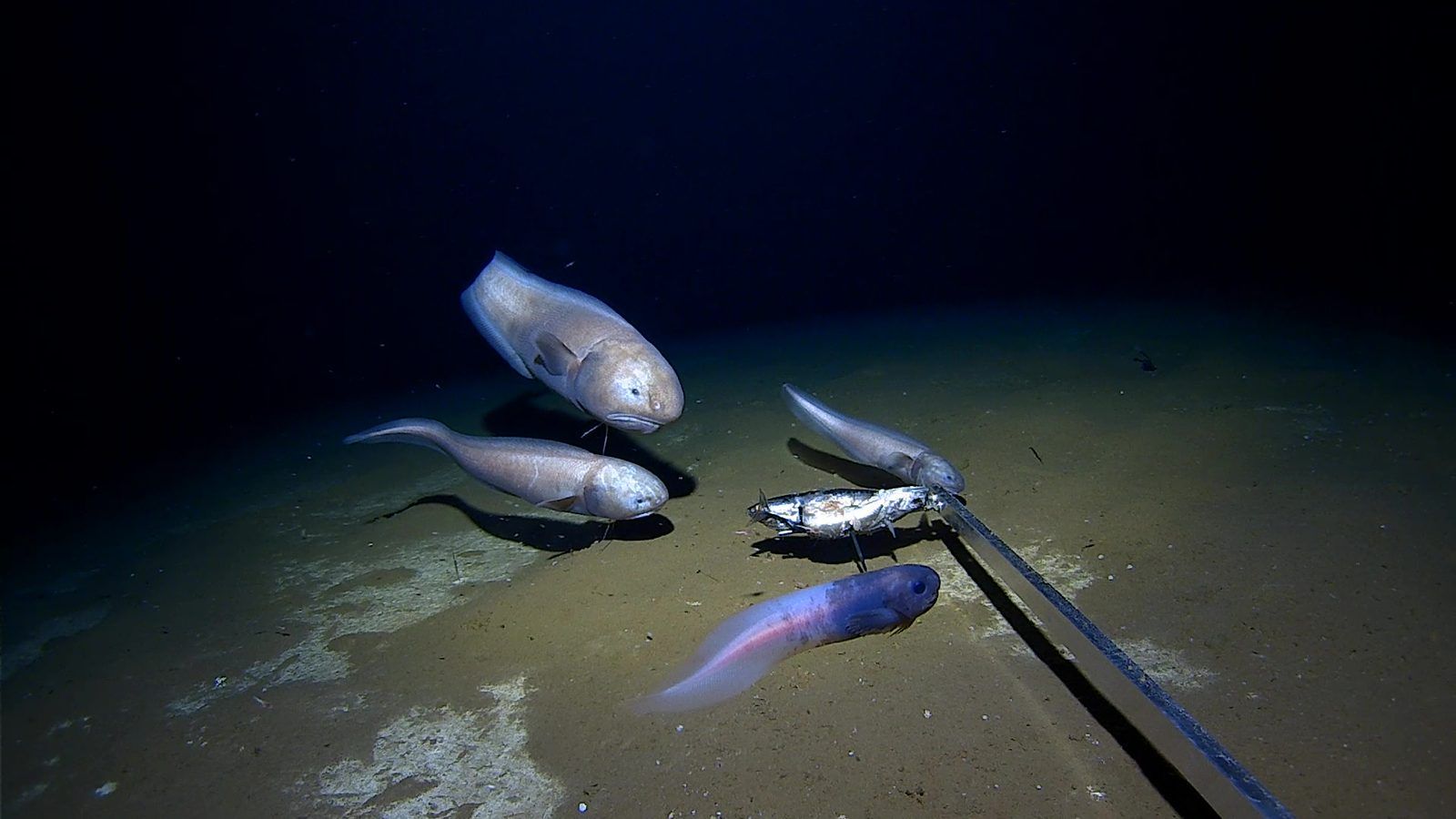
An abyssal plain at 4,000 m receives its food as marine snow, the slow drizzle of dead plankton, faecal pellets, and aggregates that sinks from the surface. By the time it has fallen four kilometres most of it has been eaten, and under a productive surface ocean the flux of organic carbon arriving at 4,000 m is well under a gram per square metre per year. Everything that lives on the plain, from the sea cucumbers to the rattail fishes, lives on that budget.
A whale that dies at sea and sinks arrives as a lump of 40 tonnes or more in one place at one time. The arithmetic is worth doing. A carcass of that size holds a few tonnes of carbon, say five. Under a productive surface the carbon flux reaching 2,000 m is about 2 g per square metre per year, which is 20 kg per hectare per year. Five tonnes divided by 20 kg a year is about 250 years: one carcass delivers to the patch of seafloor around it roughly as much food as a hectare of that seafloor would otherwise receive in a couple of centuries. Craig Smith, who has studied whale falls since the 1980s, reached the same order of magnitude in a review with Amy Baco in 2003. Unit 15 of the masterclass runs the calculation with the Martin curve from Unit 8, which is where the flux figures come from.
The three stages
Smith's work on carcasses that his group sank deliberately off California, and on others found by chance, showed that a whale fall runs through a succession that can be timed.
The first stage is the mobile scavenger stage, and it begins within hours. Hagfish, sleeper sharks, rattails, and swarms of amphipods and other crustaceans arrive from kilometres around and strip the soft tissue at a rate of 40 to 60 kg a day. For a large whale this takes from several months to about two years, and at the end of it the skeleton lies clean on the sediment.
The second is the enrichment opportunist stage. The sediment around the carcass is now loaded with fat, fragments, and the scavengers' waste, and small polychaete worms, snails, and crustaceans colonize it at densities of tens of thousands per square metre, far above anything on the surrounding plain. Many of them are species found only at whale falls or at other sudden food sources, and they appear to spend their lives moving from one to the next as larvae. This stage lasts months to a few years.
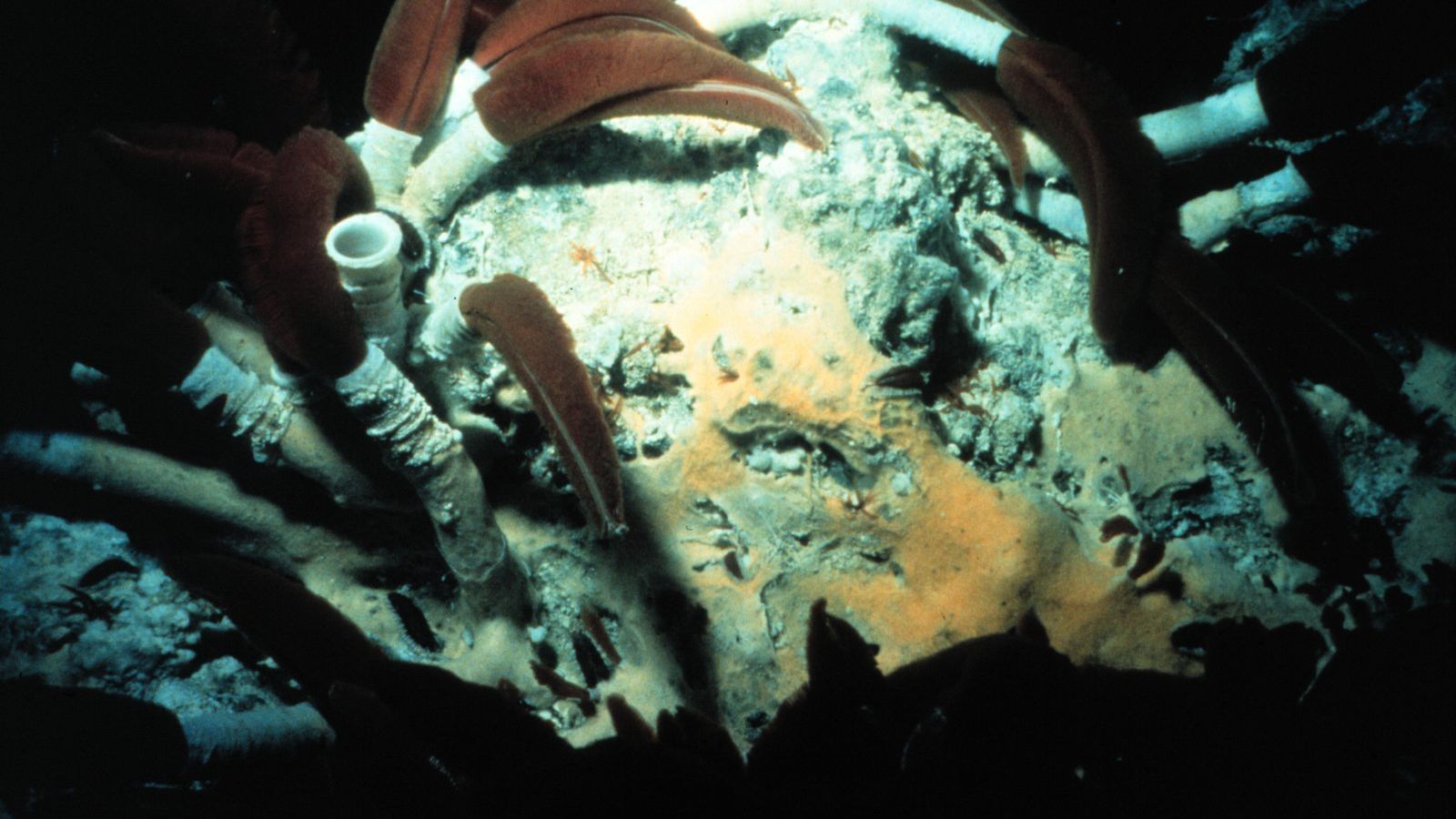
The third is the sulfophilic stage, and it lasts longest. Whale bone is up to 60 per cent fat by mass, and as bacteria break that fat down inside the bone, without oxygen, they produce hydrogen sulfide. The sulfide seeps out of the bone and feeds the same kind of chemosynthetic bacteria that live at hydrothermal vents and cold seeps, and the same kinds of animals follow: mats of white bacteria on the bones, mussels and clams with bacteria in their gills, and tube worms. A large skeleton can support this community for decades, and estimates for the biggest whales run to 50 years or more. It is during this stage that Osedax does its work, and the worms are also one of the reasons the stage ends, because they dissolve the bone.
Stepping stones
The animals of the sulfophilic stage are the link between whale falls and the rest of deep-sea biology. Vents and seeps are hundreds or thousands of kilometres apart, and the larvae of their animals cannot drift that far on their own supply of yolk. A whale fall between them, supplying sulfide for decades, is a place where a larva can settle, grow, and release larvae of its own. Before whaling there were many more large whales in the sea, and so many more carcasses on the seafloor, spaced perhaps only a few kilometres apart along the migration routes, and it has been argued that the dispersal of vent and seep animals depended in part on that network. Whaling removed most of it within a century.
The worm
Osedax turned out to be far more than a curiosity. More than 30 species are now known, from the Pacific, the Atlantic, the Antarctic, and the Mediterranean, at depths from 20 m to more than 4,000 m. The worms you see are all female. The males are microscopic, dozens or hundreds of them living inside the tube of each female, never growing beyond the larval stage, and they do nothing but fertilize her eggs. Fossil whale bones from the Oligocene epoch, about 30 million years old, carry the characteristic borings of the worms, which means the group has been eating whales for about as long as there have been whales to eat, and borings in older bones suggest it ate marine reptiles before that. The Monterey Bay Aquarium Research Institute keeps a summary of its whale fall work, with video of the bones.
Finding them
Natural whale falls are rare finds. A whale that dies at sea has a reasonable chance of sinking rather than floating, and estimates suggest that several hundred thousand large whale carcasses lie on the seafloor at any time, but the seafloor is 360 million km² and a carcass covers a few tens of square metres. Most known falls were found by vehicles that were looking for something else, as in 2019, when a telepresence expedition in the Monterey Bay National Marine Sanctuary came across a fresh fall on the Davidson Seamount at about 3,200 m, with octopuses, eelpouts, and bone-eating worms already at work. The sunk carcasses that Smith's group and others placed deliberately, with their positions known, are what made the timeline above possible.
Unit 15 of the Marine Biology Masterclass covers the abyssal plains and their food supply, whale falls with their three stages and durations, the hadal trenches, and the biology of pressure. Unit 14 covers the vents and seeps whose animals a whale fall hosts, and Unit 8 supplies the Martin curve. The full outline is in the curriculum.