 Image: OldMateWA (CC BY-SA 4.0)
Why no fish has been found below about 8,400 metres
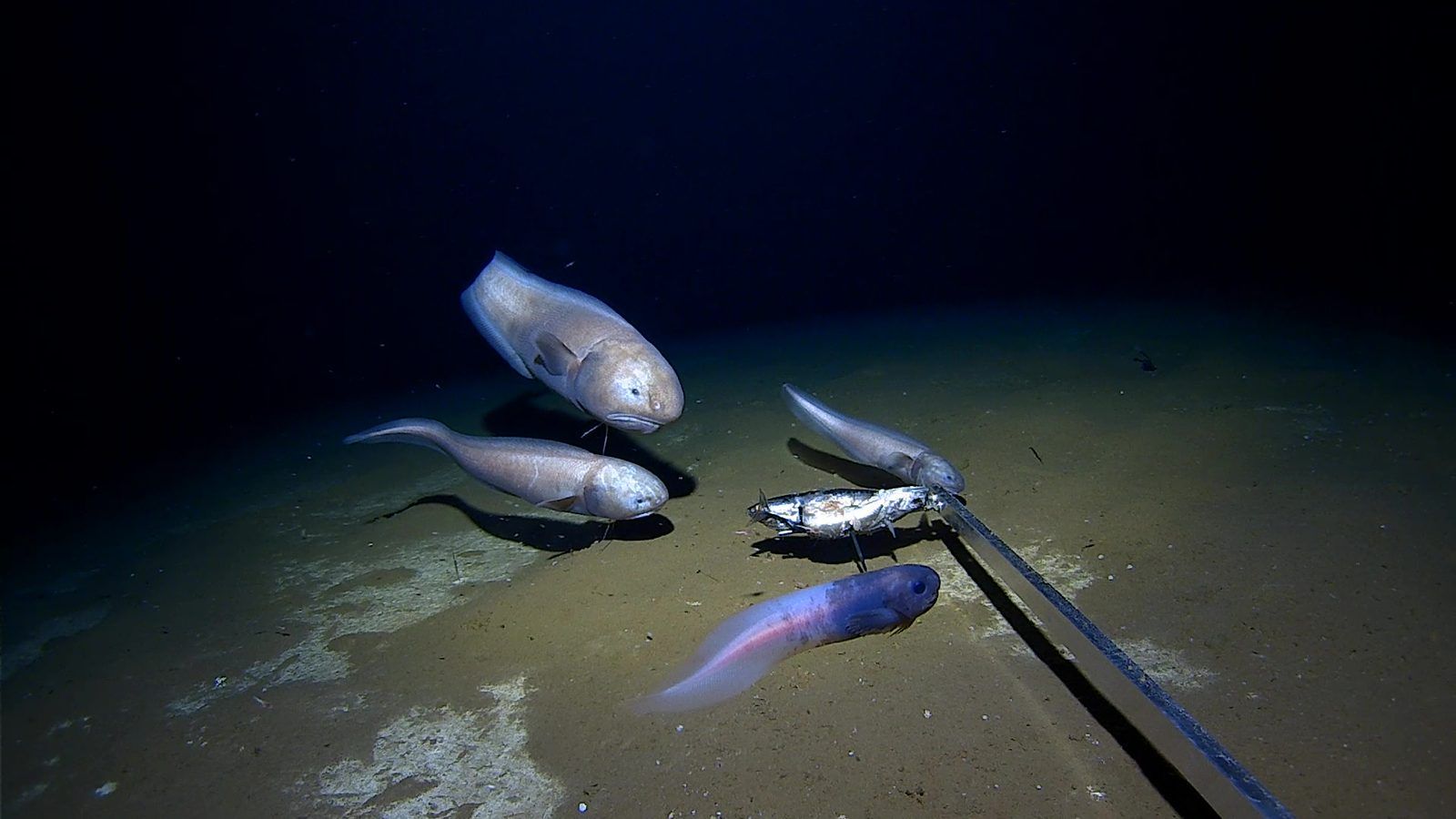
The deepest fish anyone has seen was a snailfish about 20 cm long, filmed in August 2022 at 8,336 m in the Izu-Ogasawara Trench south of Japan by a baited camera lander from the Minderoo-UWA Deep-Sea Research Centre. A few days later the same expedition brought two snailfish up from 8,022 m in the neighbouring Japan Trench, the deepest ever caught. The record before that was 8,178 m, in the Mariana Trench in 2017. The trenches go on down to 10,935 m, and the landers that filmed the fish have been to the bottom of several of them, where there are amphipods, sea cucumbers, and single-celled animals the size of a fist. No fish has been seen there. The reason appears to be chemistry.
What pressure does
The pressure in the sea rises by about one atmosphere for every 10 m of depth. At 8,336 m it is close to 840 atmospheres, or 84 megapascals, and the arithmetic is worth doing once. The pressure at depth \(z\) is the weight of the water column above, \(p = \rho g z\), and with seawater at 1,030 kg per cubic metre, \(g\) at 9.81 m per second squared, and \(z\) at 8,336 m that gives 84.2 megapascals, plus one atmosphere of air pressure on top. For comparison, the pressure in a car tyre is about 0.2 megapascals above atmospheric.
Pressure does not crush a fish. A fish has no air spaces at that depth, and water barely compresses, so the body is at the same pressure inside and out. What pressure does is subtler. It acts on anything that changes volume, and the folding of a protein, the binding of an enzyme to its substrate, and the assembly of a cell membrane all involve small changes in volume. At several hundred atmospheres those reactions shift. Proteins that work at the surface fold wrongly, membranes stiffen, and the machinery of the cell runs slow or stops.
The molecule that fixes it
Marine fishes carry a small organic molecule in their cells called trimethylamine oxide, or TMAO. Sharks use it in quantity to balance the urea in their blood, and bony fishes use a little of it as part of their osmotic balance. In 2014 Paul Yancey and colleagues, including Alan Jamieson, who later led the 2022 expedition, measured the TMAO content of the muscle of fishes caught from the surface down to 7,000 m in the Kermadec Trench, and found that it rises in a straight line with depth. Shallow fishes have around 40 millimoles per kilogram. The snailfish from 7,000 m had about 390. The paper, "Marine fish may be biochemically constrained from inhabiting the deepest ocean depths", appeared in the Proceedings of the National Academy of Sciences, and it is the first item on the reading list of Unit 15.
TMAO stabilizes proteins. It is excluded from the water that lies right next to a protein's surface, which pushes the protein towards its compact folded shape and offsets what the pressure does. A fish living deeper needs more of it, and the measurements show that this is exactly what fishes do.
Why the line has an end
TMAO is also an osmolyte, which means it adds to the osmotic concentration of the fish's body fluids. A bony fish keeps those fluids at about a third of the concentration of seawater, and that gradient is the reason a marine teleost drinks, as the post on sharks and tunas explains. Adding TMAO closes the gap. Extend Yancey's line downwards and the point at which a fish's cells would reach the concentration of seawater falls at about 8,200 m, with a range of about 8,000 to 8,500 m when the scatter in the data is allowed for.
Below that depth a fish would have to be more concentrated than the sea around it, and it would then face the opposite problem to every other bony fish: water flooding in, with no organ built to pump it out. Sharks solve this with a kidney that produces dilute urine and a gland that excretes salt, but sharks are limited in other ways, and none has been recorded below about 4,000 m. A teleost would have to reinvent a large part of its physiology to cross the line. None appears to have done so.
The 2022 record sits exactly where the prediction said the last fishes would be. Jamieson's team made the point in the paper that described it, in Deep-Sea Research Part I in 2023, and in the expedition reports of the centre. The fish at 8,336 m was a juvenile, and the adults of these species seem to live a little shallower, which fits a population pressed against a ceiling it cannot pass.
The fishes that live there
The hadal snailfishes belong to the family Liparidae, a group of soft, tadpole-shaped fishes with no scales and a gelatinous skin, most of whose 400 or so species live in cold shallow water. A handful of species have moved into the trenches, each trench apparently with its own, and they are the top predators there, eating the swarms of amphipods that gather on anything that falls to the bottom. The Mariana snailfish (Pseudoliparis swirei), described in 2017, was named for Herbert Swire, an officer on HMS Challenger, the expedition that found the trench in 1875. Its skull is incompletely ossified and its body is full of a watery gel, both of which look like adaptations to a world where pressure and the cost of building bone both argue against a heavy skeleton.
The prediction is a prediction, and the authors of the TMAO paper said so. A fish could in principle evolve a different stabilizer, or a shark-like way of handling a concentrated body fluid. The test is more landers, at more trenches, for more hours. So far, after thousands of hours of hadal video, the line has held.
Unit 15 of the Marine Biology Masterclass covers the abyssal plains, the hadal trenches, the biology of pressure and cold, TMAO against depth with the fish records plotted on it, whale falls, and the history of hadal exploration from Trieste in 1960 onwards. Unit 5 introduces TMAO in sharks. The full outline is in the curriculum.