 Image: Olivier Dugornay (Ifremer) (CC BY 4.0)
Ten numbers every marine biology student should know
Physics students carry equations. Marine biologists carry numbers, because the sea is a place where most of what is known was measured rather than derived, and the measured values are what let you tell a plausible claim from a wrong one. Here are ten that come up in almost every unit of the masterclass, each with the measurement behind it and with the caveat that goes with it. The key facts page collects the full set, unit by unit.
1. The ocean covers 71 per cent of the Earth and is about 3,700 m deep on average
The area is 361 million km². The mean depth comes from the global bathymetric grids, and the most careful calculation, by Matthew Charette and Walter Smith in a 2010 paper in Oceanography, gives 3,682 m and a volume of 1.33 billion km³. The number to keep is that the average point in the ocean is nearly four kilometres from the surface, in the dark, at about 2 °C and under about 370 atmospheres. The sunlit sea that most people picture is a thin skin.
2. A salinity of 35
Seawater holds about 35 g of dissolved salts per kilogram, and marine biologists write that as a salinity of 35 with no unit, on the practical salinity scale that is defined from electrical conductivity. The global mean is 34.7. The proportions of the main ions are the same everywhere, which Marcet noticed in 1819 and Dittmar confirmed on the Challenger samples in 1884, so one measurement of conductivity gives you the whole composition.
3. The pressure rises by about 1 atmosphere for every 10 metres
Exactly, 1.01 bar per 10 m of seawater, which is why oceanographers quote pressure in decibars and treat the number as a depth. In physiology it is written as 10 megapascals per 1,000 m. At the bottom of the Challenger Deep, 10,935 m, that is about 1,100 atmospheres. The number matters because gas spaces obey it, so a fish's swim bladder or a diver's lungs shrink to half their volume in the first ten metres, and water-filled tissue does not.
4. One per cent of the light is left at about 115 m in the clearest water
Light falls off exponentially with depth, following the Beer-Lambert law, and in the clearest open ocean the attenuation coefficient is about 0.04 per metre. Then 1 per cent is left at \(\ln(100)/0.04 = 4.6/0.04 = 115\) m. That depth is the usual working definition of the bottom of the euphotic zone, where photosynthesis can still pay for itself. In coastal water with a coefficient of 0.2 per metre the same depth is 23 m, and in an estuary it can be under 5 m. The post on light in the sea works through all three.
5. The ocean fixes about 50 billion tonnes of carbon a year
Marine primary production is about 50 petagrams of carbon a year, where a petagram is 10¹⁵ g, one billion tonnes. The estimate comes from satellite chlorophyll fed into production models, and the standard reference is a 1998 paper by Christopher Field and colleagues that put the ocean's share at 48.5 of a global 104.9. The ocean does about half of the world's photosynthesis with less than 1 per cent of its photosynthetic biomass, because phytoplankton are replaced about once a week while a forest stands for a century.
6. About 10 per cent of the energy passes from one trophic level to the next
Raymond Lindeman proposed the figure in 1942 from measurements in a Minnesota lake, and in the sea the measured range is about 5 to 20 per cent. The consequence is that the production of a sea at trophic level 4, where tuna and cod sit, is about a thousandth of the primary production. Fifty billion tonnes of carbon fixed a year becomes, after three steps, about 50 million tonnes of carbon in large fish, and the world's catch converted to carbon is a sizeable fraction of that. The number is a rule of thumb, and the range is the real information.
7. Redfield's ratio, 106 carbon to 16 nitrogen to 1 phosphorus
Alfred Redfield noticed in 1934 that the ratio of nitrogen to phosphorus in deep seawater was the same as in the plankton that sank into it, about 16 to 1. The carbon number was added later, and the whole ratio, with the oxygen consumed when the material decays, is what lets a marine chemist read how much life grew in a water sample from its nutrients alone. It is an average with real scatter around it, and the deviations tell you which nutrient is limiting where.
8. About 251,000 named marine species, and perhaps 2.2 million in all
The first number is the count of accepted species in the World Register of Marine Species, which stood at about 251,000 in November 2026 and grows by around 2,000 a year. The second is the 2011 estimate of Camilo Mora and colleagues from the way higher taxa accumulate, and a survey of taxonomists a year later put the total at 700,000 to a million instead. The post on counting species explains why they disagree. Either way, most species in the sea have no name.
9. The deepest fish, 8,336 m
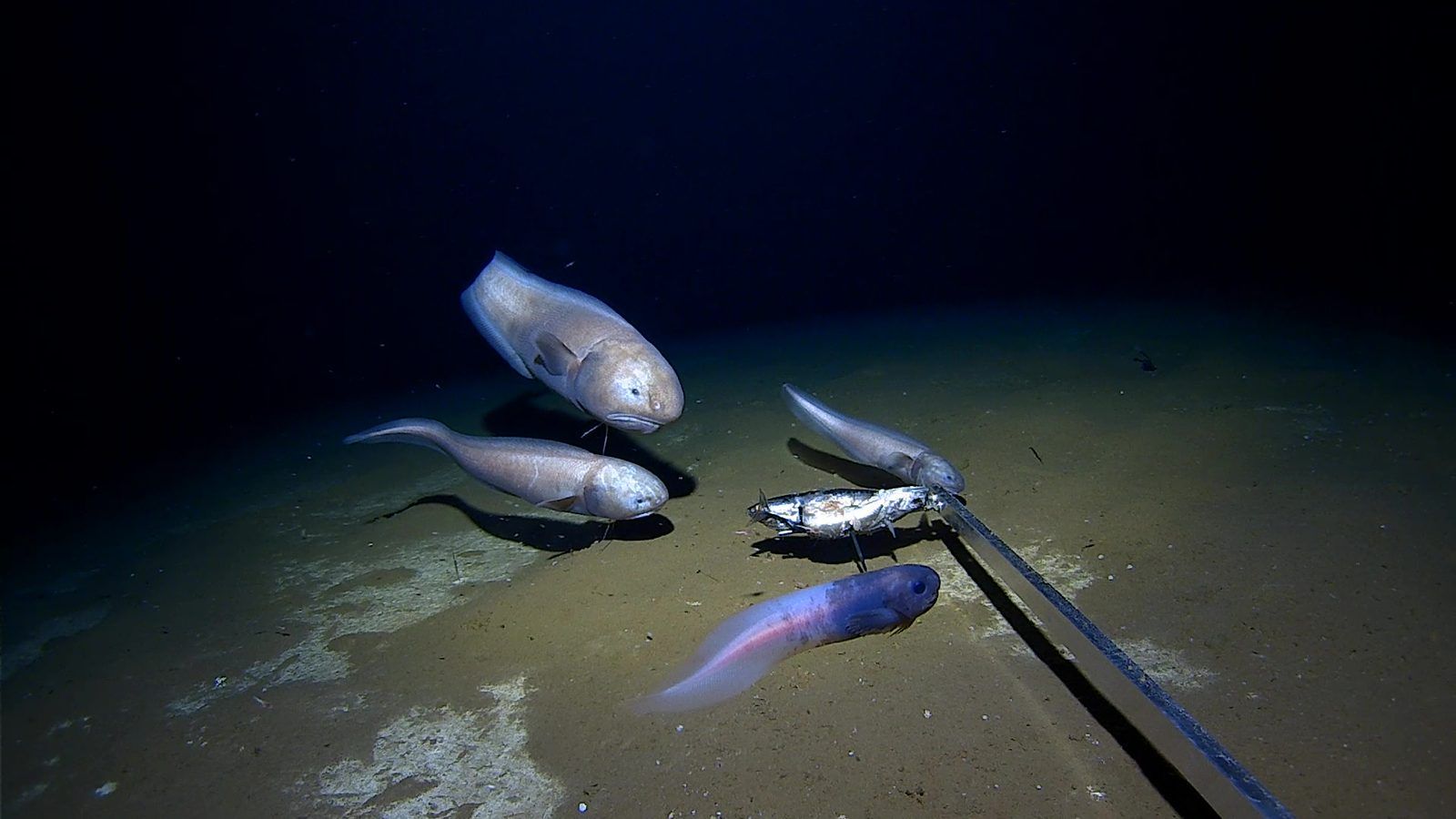
A snailfish filmed in the Izu-Ogasawara Trench in August 2022 holds the record, and the prediction from the chemistry of fish cells is that nothing will be found much below about 8,200 to 8,400 m. The deepest mammal dive is 2,992 m and the longest 137.5 minutes, both by Cuvier's beaked whales off California, from satellite tags reported in 2014. The trenches go to 10,935 m, so there is a layer of nearly three kilometres at the bottom of the sea where there are animals and no fish.
10. The world's fish catch peaked at about 130 million tonnes in 1996
The reported figure for that year was 86 million tonnes. The reconstruction by Daniel Pauly and Dirk Zeller, published in 2016, added the unreported small-scale, recreational, discarded, and illegal catches and found a peak half again as high, falling since by about 1.2 million tonnes a year. The two numbers together, the reported and the reconstructed, are the ones to carry, because the gap between them is the measure of how much of the world's fishing is invisible to the statistics.
Honourable mentions
Three more that nearly made the list. The giant tube worm grows more than 85 cm a year, the fastest of any marine invertebrate, and giant kelp up to 50 cm a day. There are about 3 × 10²⁷ cells of Prochlorococcus in the sea, a count with 28 digits that comes from flow cytometry and a model. And a Greenland shark can live for at least 272 years, measured from the radiocarbon in the lens of its eye in 2016, with the largest animal in that study estimated at 392 years give or take 120. Every one of these has a unit of the masterclass behind it, and each is stated there with its measurement and its uncertainty. The full list is on the key facts page and the outline of the units is in the curriculum.