 Image: Narrissa P Spies (CC BY-SA 4.0)
What happens inside a coral when it bleaches
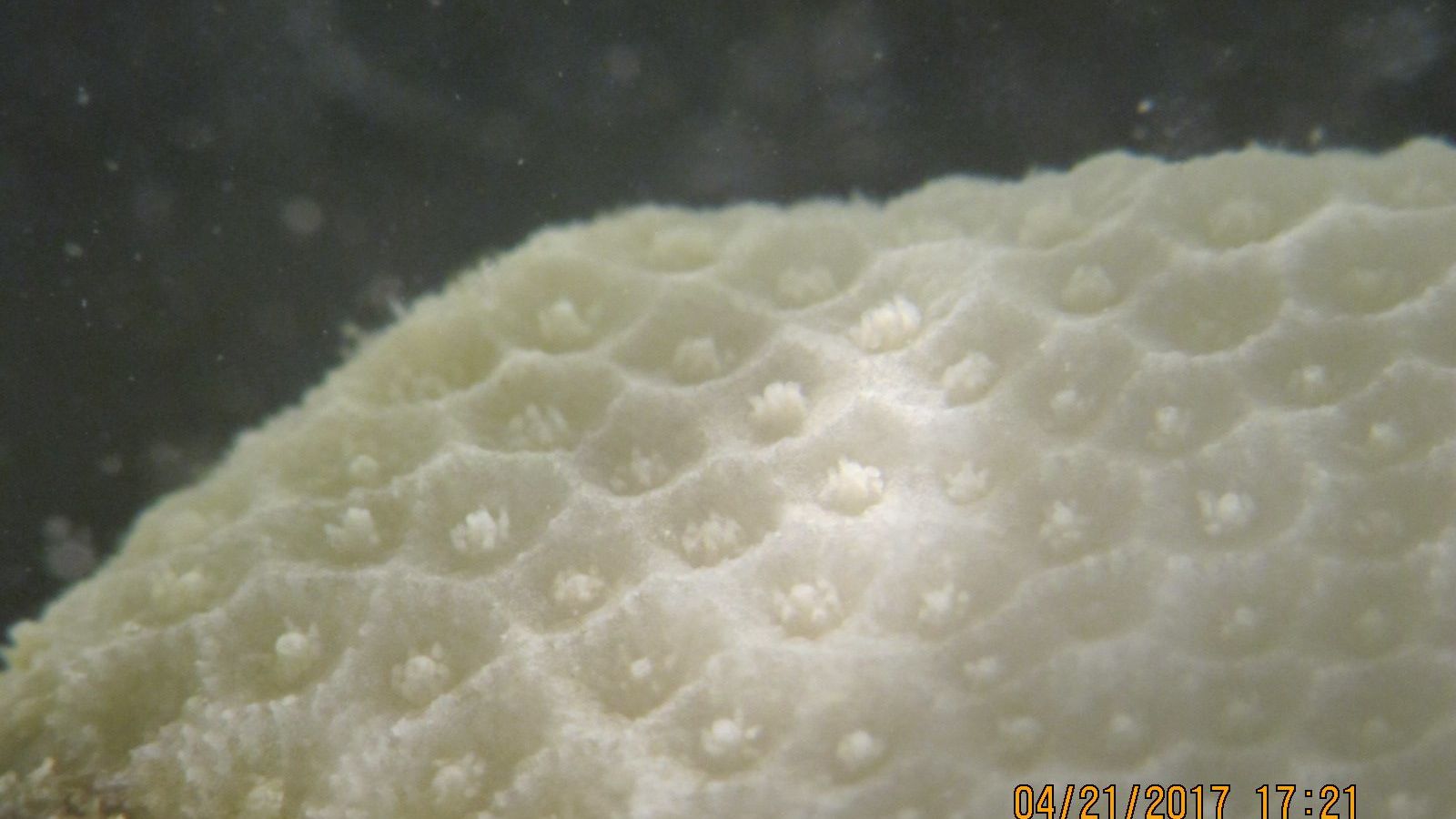
A healthy stony coral is brown, green, or dull orange, and almost none of that colour belongs to the coral. It belongs to single-celled dinoflagellates of the family Symbiodiniaceae, long called zooxanthellae, which live inside the cells of the coral's inner tissue layer at densities of one to several million cells per square centimetre. When a coral bleaches it loses those cells, the tissue turns transparent, and the white aragonite skeleton underneath shows through. The animal is still there. Whether it stays alive depends on what happens in the following weeks.
The partnership
The symbionts photosynthesize, and they pass most of what they make to the coral as sugars, glycerol, and amino acids. Measurements on shallow-water corals find that this supply can cover more than 90 per cent of the animal's daily energy needs, which is how a reef grows in the clear, nutrient-poor water of the tropics where there is little plankton to catch. In return the coral gives the algae a protected place in the light and a supply of the nitrogen and carbon dioxide from its own metabolism. The arrangement also drives calcification: corals lay down skeleton several times faster in the light than in the dark.
The weak point is that the algae sit in the light inside an animal that cannot move out of it. Photosynthesis runs on a machinery that is easily damaged by too much light, and the repair of that damage is sensitive to temperature.
What heat does
When the water stays about 1 °C above the warmest temperature the reef normally sees in summer, and stays there for weeks, the photosynthetic apparatus of the symbionts begins to fail. The damage starts in photosystem II, the protein complex that splits water, and in the enzymes that fix carbon. Light energy that can no longer be used in photosynthesis is passed to oxygen instead, which produces reactive oxygen species, the same molecules that cause oxidative damage in any cell. They leak from the alga into the coral's tissue.
The coral responds as an animal responds to an infection. It expels the symbionts, by ejecting them from its cells, by digesting them, or by shedding whole cells into the water. Within days the density of algae can fall by 80 or 90 per cent. The coral's own pigments, the fluorescent proteins that give some species their pink or blue tints, are sometimes left behind, which is why a bleaching reef can briefly look bright before it turns white.
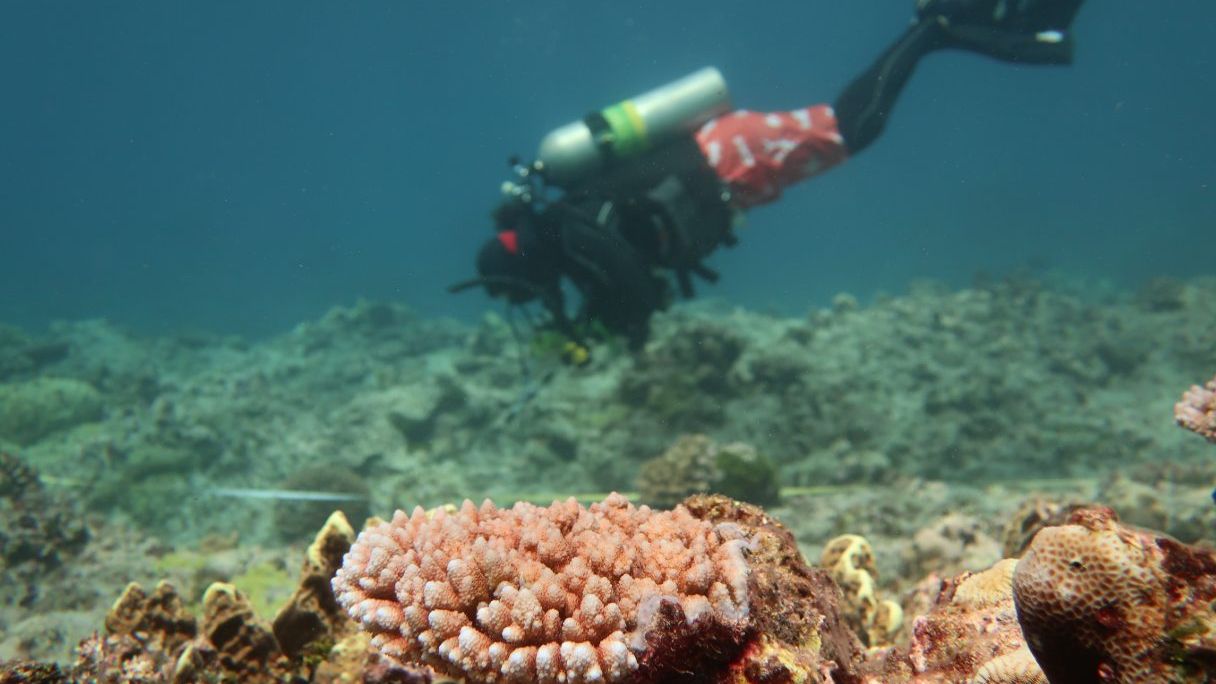
A bleached coral keeps feeding on plankton with its tentacles and lives on its fat reserves. Species with thick tissue and large polyps, such as the massive Porites, can last for weeks or months like this. Thin-tissued branching corals of the genus Acropora, which grow fastest and build most of the structure of a Pacific reef, run out first. If the water cools in time the surviving symbionts multiply back, and the coral recovers its colour within a few months. If it does not, the tissue starves, dies, and is colonized by filamentous algae within days.
How a forecast is made
The relationship between heat and bleaching is regular enough to be turned into a forecast, and the National Oceanic and Atmospheric Administration's Coral Reef Watch has been issuing one from satellite sea-surface temperatures since 1997. The method starts from the maximum monthly mean, the temperature of the warmest month in the long-term record for each 5 km square of ocean. Any week in which the temperature exceeds that value by at least 1 °C counts, and the excess is added up over a rolling window of 12 weeks. The sum is the Degree Heating Weeks figure for that square, with the unit of °C-weeks.
Take a reef whose warmest month averages 29.0 °C. Suppose the water sits at 30.0 °C for six weeks, then at 30.5 °C for two more. The first six weeks each add 1.0 and the last two each add 1.5, for a total of 9 Degree Heating Weeks. The alert levels of Coral Reef Watch are set at 4, where significant bleaching is likely, and 8, where severe bleaching and mortality are likely. This reef has crossed both. The methodology page gives the definitions, and Unit 10 of the masterclass has an interactive in which you compute the number from a real 12-week temperature record.
The global events
Bleaching on the scale of whole ocean basins was first recorded in 1998, during a strong El Niño, when an estimated 16 per cent of the world's corals died. A second global event followed in 2010 and a third ran from 2014 to 2017, the longest on record, during which the Great Barrier Reef bleached severely in two consecutive summers for the first time. Terry Hughes and colleagues documented the 2016 event along the whole length of the reef in a paper in Nature in 2017, and showed that past exposure to bleaching gave reefs no protection against the next one. In April 2024 NOAA confirmed a fourth global event, which began in 2023 and by 2025 had touched reefs in every tropical ocean, reaching a larger share of the world's reef area than any before it.
How long recovery takes
When the corals survive, the reef looks normal again within a year. When they die, recovery means regrowth from larvae and from surviving fragments, and the timescale is set by growth rates. Branching Acropora can add 10 to 20 cm a year and a reef dominated by it can rebuild much of its cover in 10 to 15 years if nothing else goes wrong. Massive corals grow about a centimetre a year, so a colony the size of a car is centuries old and is not replaced within anyone's lifetime. With severe heat now returning every few years on many reefs, the interval between events has become shorter than the recovery time, and that arithmetic is the heart of the problem.
Some corals do better than others. In a back-reef pool on Ofu Island in American Samoa, corals that experience daily temperature swings of several degrees survive heat that kills their neighbours a few hundred metres away, partly by keeping their heat-stress genes switched on in advance. Stephen Palumbi's group showed this from gene expression in 2013, and Unit 10 of the masterclass presents the paper as its research spotlight, together with the difference between a coral that acclimatizes within its lifetime and a population that adapts across generations.
Unit 10 of the Marine Biology Masterclass covers the symbiosis, calcification, the Degree Heating Weeks calculation, and the global events in detail. Unit 8 places reefs in the ocean's carbon system. The full outline is in the curriculum.