 Image: Albert kok (CC BY-SA 3.0)
Why a shark does not drink seawater and a tuna does
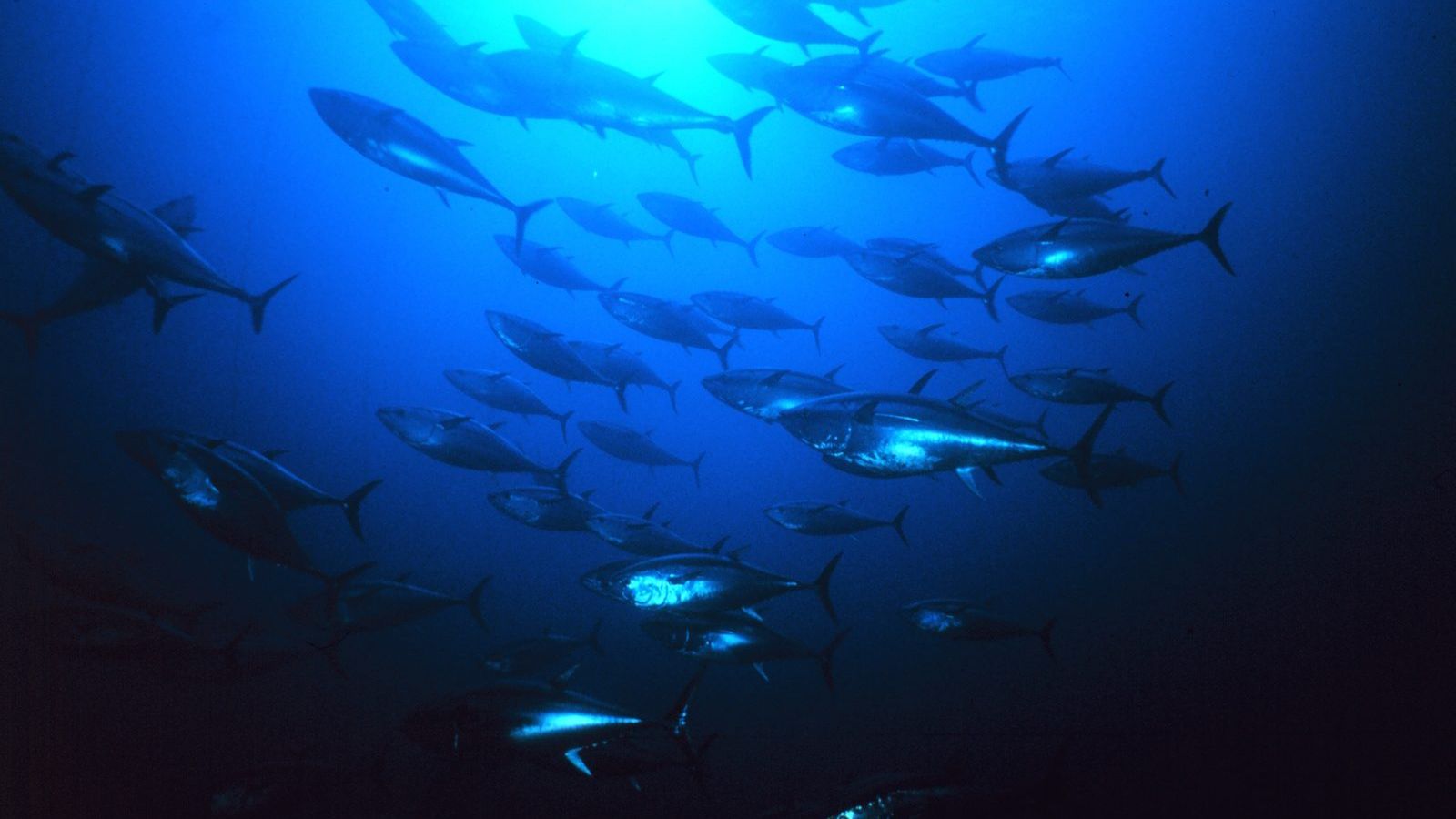
A litre of seawater holds about 35 g of dissolved salts, which gives it an osmotic concentration of roughly 1,000 milliosmoles per kilogram. The blood of an Atlantic bluefin tuna (Thunnus thynnus) sits at 300 to 400 milliosmoles per kilogram, about the same as yours. The two liquids are separated by the gills, a membrane built to be as thin and as permeable as possible so that oxygen can cross it. Water crosses it too, in the wrong direction. A marine bony fish is a bag of dilute fluid soaking in brine, and it loses water through its gills every second of its life.
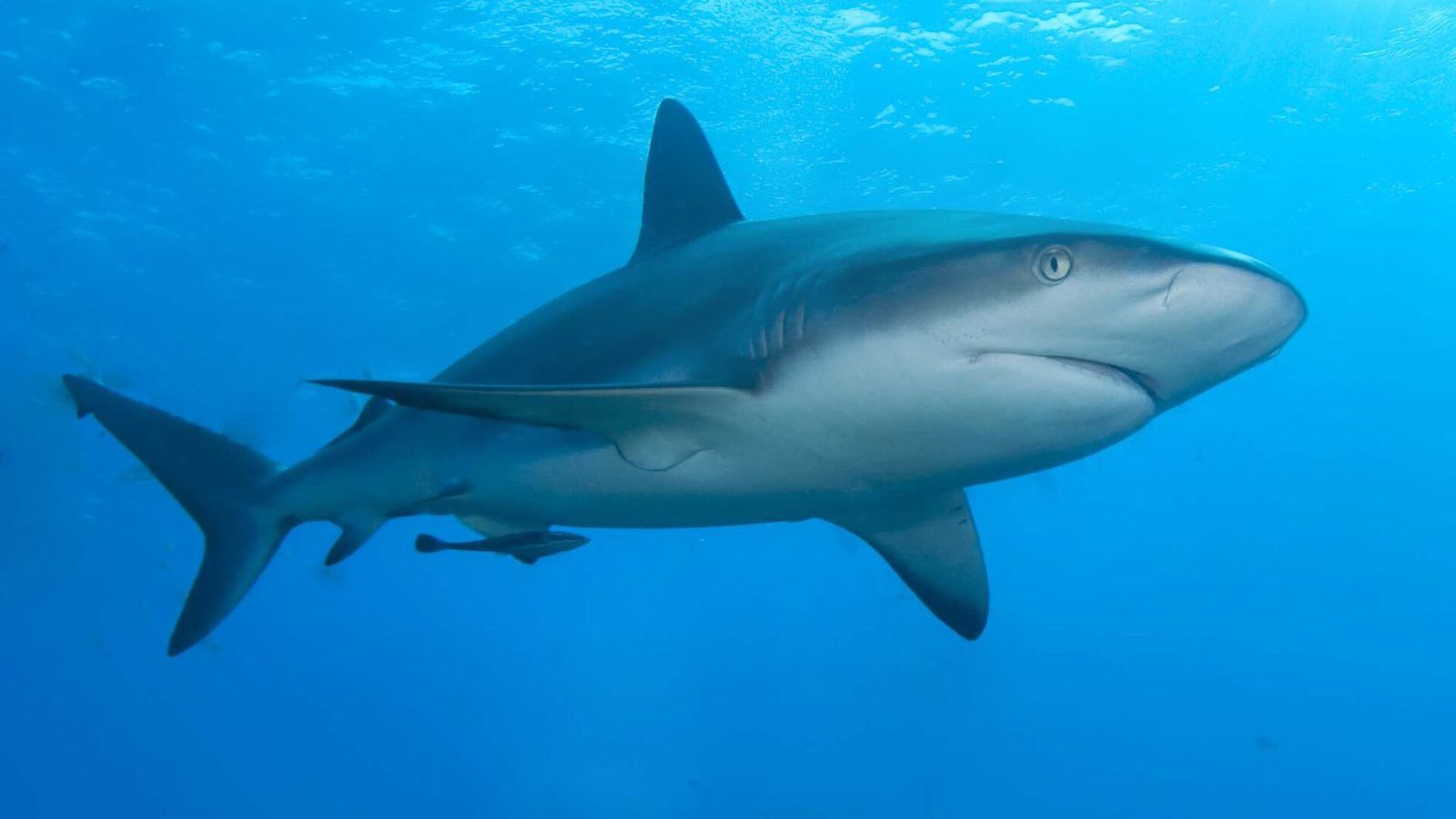
A shark swimming beside it faces the same sea with the same kind of gills and does not have the problem. The reason is one of the neater pieces of physiology in the sea, and it was worked out in the 1930s by the American physiologist Homer Smith, who spent his summers measuring the blood and urine of dogfish and skates.
The bony fish drinks
The ray-finned fishes, the group that includes tunas, cod, herring, and almost everything else with scales and fins, keep their blood at roughly a third of the concentration of seawater. The gradient across the gills is therefore about 650 milliosmoles per kilogram, and water leaves the fish by osmosis. The only way to replace it is to swallow seawater, so a marine teleost drinks, at a rate of a few millilitres per kilogram of body mass per hour. Over a day that comes to somewhere between 5 and 15 per cent of its own mass, depending on the species and the temperature.
Drinking seawater makes the salt problem worse before it makes the water problem better. The gut absorbs the water together with sodium and chloride, so every litre of water gained brings in salt that has to go out again. The kidney cannot do it, because a fish kidney cannot make urine more concentrated than blood. Instead the salt is pumped out by specialized cells in the gills, the ionocytes, long called chloride cells. Each one is packed with mitochondria and with a sodium-potassium pump on its inner membrane, and it moves chloride ions, followed by sodium, from the blood back into the sea against the gradient. The kidney deals with what the gills cannot handle, the magnesium and sulfate ions, which it excretes in a small volume of urine.
The energy cost of all this is not trivial. Estimates for the share of a marine teleost's resting metabolism spent on salt and water balance run from a few per cent to more than 10 per cent, which is one reason why the question "how much does a fish have to drink" gets a precise answer in physiology textbooks and in Unit 5 of the masterclass.
The shark matches the sea
A shark, a ray, or a chimaera takes a different route. Its blood has about the same concentration of sodium and chloride as a bony fish's, around 250 to 300 millimoles per litre each, so it is just as dilute in salt. What it adds is urea, at 350 to 400 millimoles per litre, roughly a hundred times the concentration in human blood, and a second small molecule, trimethylamine oxide or TMAO, at 70 to 100 millimoles per litre. Together these bring the osmotic concentration of the blood up to about 1,000 milliosmoles per kilogram, and in most species a little above it.
The consequence is that water does not leave a shark. If anything it trickles in through the gills, because the blood is slightly more concentrated than the sea, and the kidney excretes the surplus as a dilute urine. The shark does not need to drink, and measurements of drinking rates in dogfish find values close to zero. Smith published the essentials of this in 1931, after showing that the urea was retained on purpose: the shark kidney reabsorbs it from the filtrate rather than letting it go.
Salt still enters a shark, with its food and by diffusion through the gills, and sharks have a dedicated organ for getting rid of it. The rectal gland, a finger-sized organ that opens into the end of the gut, secretes a fluid that is almost pure sodium chloride at about 500 millimoles per litre, twice the concentration of the blood. Physiologists have used the rectal gland as a model system for chloride transport for decades because it does one thing and does it strongly.
Why the TMAO is there
Urea at 400 millimoles per litre is not harmless. It unfolds proteins, which is why it is used in the laboratory to denature them. A shark's enzymes work in that solution because of the TMAO, which stabilizes protein structure and cancels the effect of urea almost exactly when the two are present at a ratio of about two to one. That is the ratio found in shark blood, and the same balance turns up in the coelacanth, a lobe-finned fish that evolved urea retention independently.
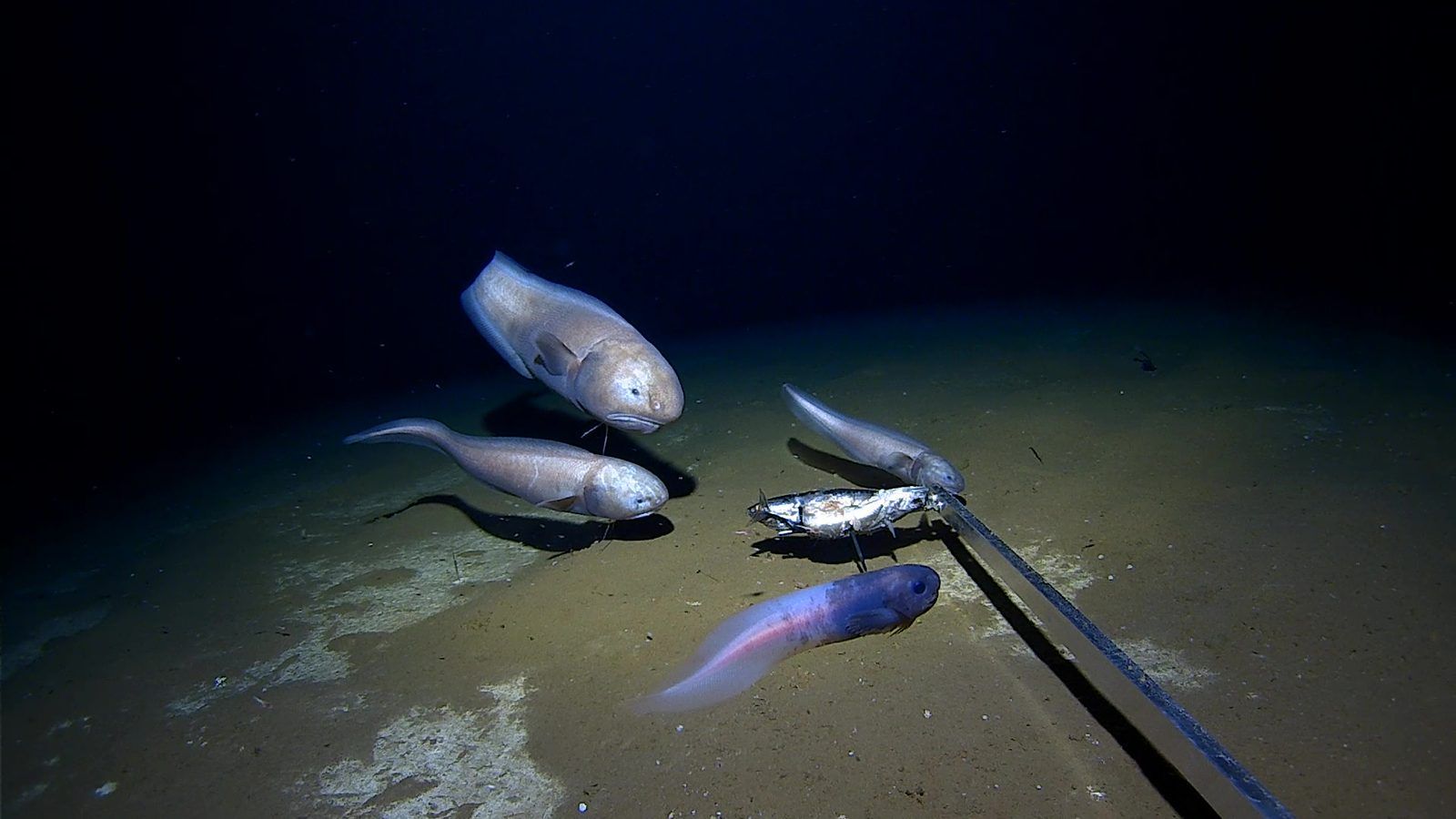
TMAO has a second life in the deep sea. The deeper a fish lives, the more of it its muscles contain, because the molecule also protects proteins against pressure. The hadal snailfishes of the trenches have so much TMAO that their cells are approaching the concentration of seawater, and the extrapolation of that trend is why no fish is expected below about 8,200 m. The post on the deepest fish works through that argument. It is the same molecule doing the same job in two different problems.
The numbers side by side
| Fluid | Osmotic concentration (mOsm/kg) | Main solutes |
|---|---|---|
| Seawater, salinity 35 | about 1,000 | Sodium and chloride |
| Marine teleost blood | 300 to 400 | Sodium and chloride |
| Shark blood | about 1,000 or a little more | Sodium, chloride, urea, TMAO |
| Hagfish blood | about 1,000 | Sodium and chloride, matched to the sea |
The hagfish row is the oldest solution of all. Hagfishes, the jawless scavengers of the deep seafloor, simply let their blood salts match the sea. They are osmoconformers and ion conformers at once, and so are nearly all marine invertebrates. The teleost and the shark are the two ways a vertebrate with a dilute blood can live in brine, and the fossil record suggests the dilute blood came first, in fresh water, which is why the problem exists at all.
What happens when the sea is not the sea
The system is not rigid. The bull shark (Carcharhinus leucas) swims hundreds of kilometres up rivers, and as the salinity falls it drops the urea in its blood by about half and lets the kidney flush the rest. The river stingrays of the Amazon, in the family Potamotrygonidae, have been in fresh water for so long that they have lost the ability to retain urea altogether, and their rectal gland has shrunk to a remnant. A salmon going the other way, from a river to the sea, rebuilds its gills in a few days, multiplying its ionocytes and reversing the direction in which they pump.
Unit 5 of the Marine Biology Masterclass puts the two balance sheets side by side with a drawing of each fish and works through how much water a one-kilogram teleost loses and must drink in a day. Unit 15 returns to TMAO at the bottom of the trenches. The full outline is in the curriculum.