 Image: Jerry Kirkhart from Los Osos, Calif (CC BY 2.0)
The sea star that taught ecologists what a keystone species is
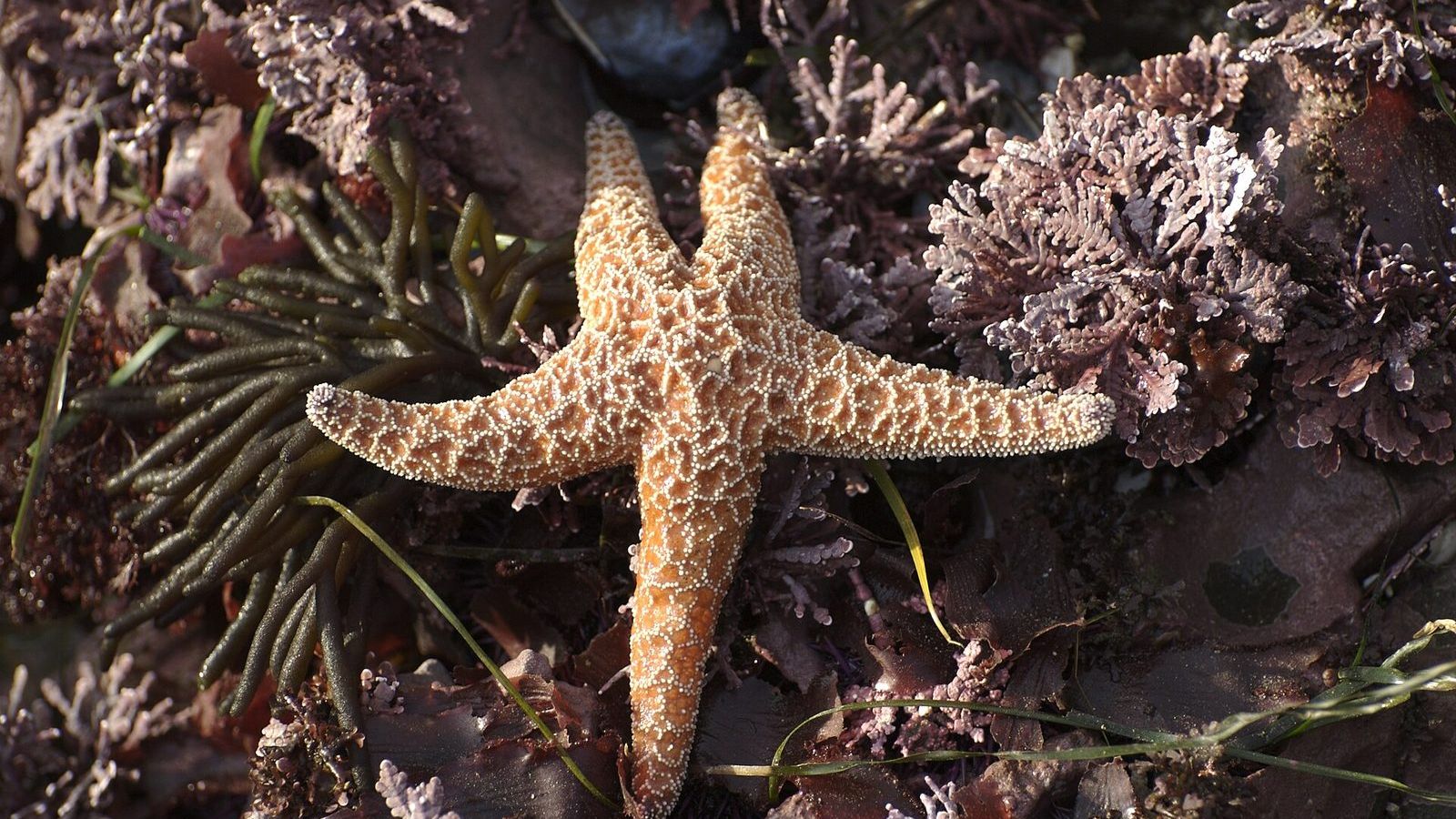
In June 1963 a young ecologist named Robert Paine began visiting a stretch of rocky shore at Mukkaw Bay, on the outer coast of Washington State, to remove sea stars. The ochre sea star (Pisaster ochraceus) is the top predator of that shore, a purple or orange animal the width of a dinner plate that eats mussels by prising the shells apart and pushing its stomach inside. Paine picked every one off an 8 m length of rock and flung it into deeper water, and he came back once or twice a month for five years to do it again. A neighbouring stretch was left alone as the control.
What happened
The control plot stayed as it was: a band of mussels in the middle of the shore, with barnacles, limpets, chitons, sea anemones, sponges, and several kinds of seaweed below and among them, fifteen species in all. On the plot without sea stars the barnacles took over first, within a few months. Then the California mussel (Mytilus californianus) settled on the barnacles and crowded them out, and over the following years the mussel band spread downwards, about a metre lower than its edge on the control plot, over the rock that the other species had occupied. The seaweeds were overgrown. The animals that graze seaweed left or starved. By 1968 the plot held eight species, and most of its surface was a single one.
Paine published the first results in 1966 in the American Naturalist under the title "Food web complexity and species diversity", and the number everyone remembers is the fall from fifteen species to eight. Removing one species had halved the diversity of the community, and it had done so by releasing a competitor, the mussel, that the predator had been holding in check. The mussel wins any contest for space on that shore. The sea star is the only reason it does not win everywhere.
The word
In 1969 Paine wrote a short note for the same journal and in it called such a species a keystone: the single stone at the top of an arch that holds the others in place and whose removal brings the structure down. His definition was narrow. A keystone species is one whose effect on the community is large out of proportion to its abundance, through predation on a competitively dominant species. The sea stars were a small fraction of the biomass on the shore, and they decided what the shore looked like.
The term spread faster than the definition. Within twenty years it was being used for any species that mattered, which is most of them, and ecologists spent a good part of the 1990s arguing about how to narrow it again. The version most textbooks settle on today keeps Paine's core: a large effect relative to abundance, so that an elephant, which has a large effect because it is large, is a dominant species and not a keystone, while a sea star, a sea otter, or a wolf can be one.
The experiment that followed
The sea star experiment made manipulation respectable in ecology. Before Paine, most field ecology was observational: you measured what was there and reasoned about why. Paine's point was that you can find out what a species does by taking it away, and the method is now standard. The most famous follow-up is the sea otter. In 1974 James Estes and John Palmisano compared Aleutian islands with and without sea otters (Enhydra lutris), which had been hunted out of most of their range by 1911 and were recolonizing. Islands with otters had kelp forests. Islands without them had seafloors carpeted with sea urchins and almost no kelp, because the urchins the otters would have eaten had grazed it away. One predator, two trophic steps down, decided whether there was a forest. Paine later gave that pattern a name too, the trophic cascade.
The idea travelled onto land. The reintroduction of wolves to Yellowstone National Park in 1995 and the changes in elk behaviour, willow growth, and beaver numbers that followed were read through the lens of Mukkaw Bay, and the argument about how much of that cascade is real and how much is wishful is a direct descendant of the arguments about Paine's shore.
A worked number
The arithmetic of the original experiment is simple enough to redo. Species richness fell from 15 to 8, a loss of 47 per cent. The lower edge of the mussel band moved down the shore by about a metre on a shore with a tidal range of around 3 m, which on a moderately sloping rock face can mean a strip of several square metres per metre of shoreline converted from a mixed community to a monoculture. Paine also measured how fast the change ran: barnacles within months, mussels within a year, the loss of the last seaweeds over three to four years. Unit 7 of the masterclass asks you to plot those numbers and then to predict what would happen if the sea stars were put back, which is a harder question than it looks, because the mussels that have grown large are too big for a sea star to open.
The sea star today
Since 2013 the ochre sea star has been doing the experiment on itself. Sea star wasting disease, a condition in which the animal develops lesions, loses arms, and dissolves within days, killed most of the Pisaster along the Pacific coast of North America from Alaska to Mexico in 2013 and 2014, the largest marine disease outbreak ever recorded. Its cause was long uncertain; a densovirus was proposed in 2014 and later doubted, and in 2025 a bacterium of the genus Vibrio was identified as the cause in the sunflower sea star, the largest of the species hit. The MARINe network tracks the outbreak and the slow recovery at shore sites along the whole coast, with data anyone can read. On many of those shores the mussel band has moved downwards in the years since, as Paine would have predicted.
Paine died in 2016. The 8 m of rock at Mukkaw Bay, on the Makah reservation, are still studied, and the shore has been monitored for longer than almost any other in the world.
Unit 7 of the Marine Biology Masterclass covers the rocky shore, the zonation principle, Connell's barnacles, Paine's sea stars, the keystone concept, the trophic cascade in kelp forests, and the intermediate disturbance hypothesis. Unit 4 introduces the sea stars, mussels, and barnacles themselves. The full outline is in the curriculum.