 Image: Frédéric Ducarme (CC BY-SA 4.0)
What is a seagrass, and why is it not a seaweed?
A seagrass has roots, veins, flowers, pollen, and seeds. A seaweed has none of them. The two share a word and a habitat and almost nothing else, and the difference matters for how each lives, what each does for the coast, and why one of them is disappearing faster than the other.
Flowering plants that returned to the sea
Seaweeds are algae. The kelps and the wracks of a rocky shore are brown algae, the sea lettuces are green algae, and the corallines are red, and none of them is closely related to a land plant. They attach to rock with a holdfast that holds and does not absorb, they take up nutrients across their whole surface, and they reproduce with spores.
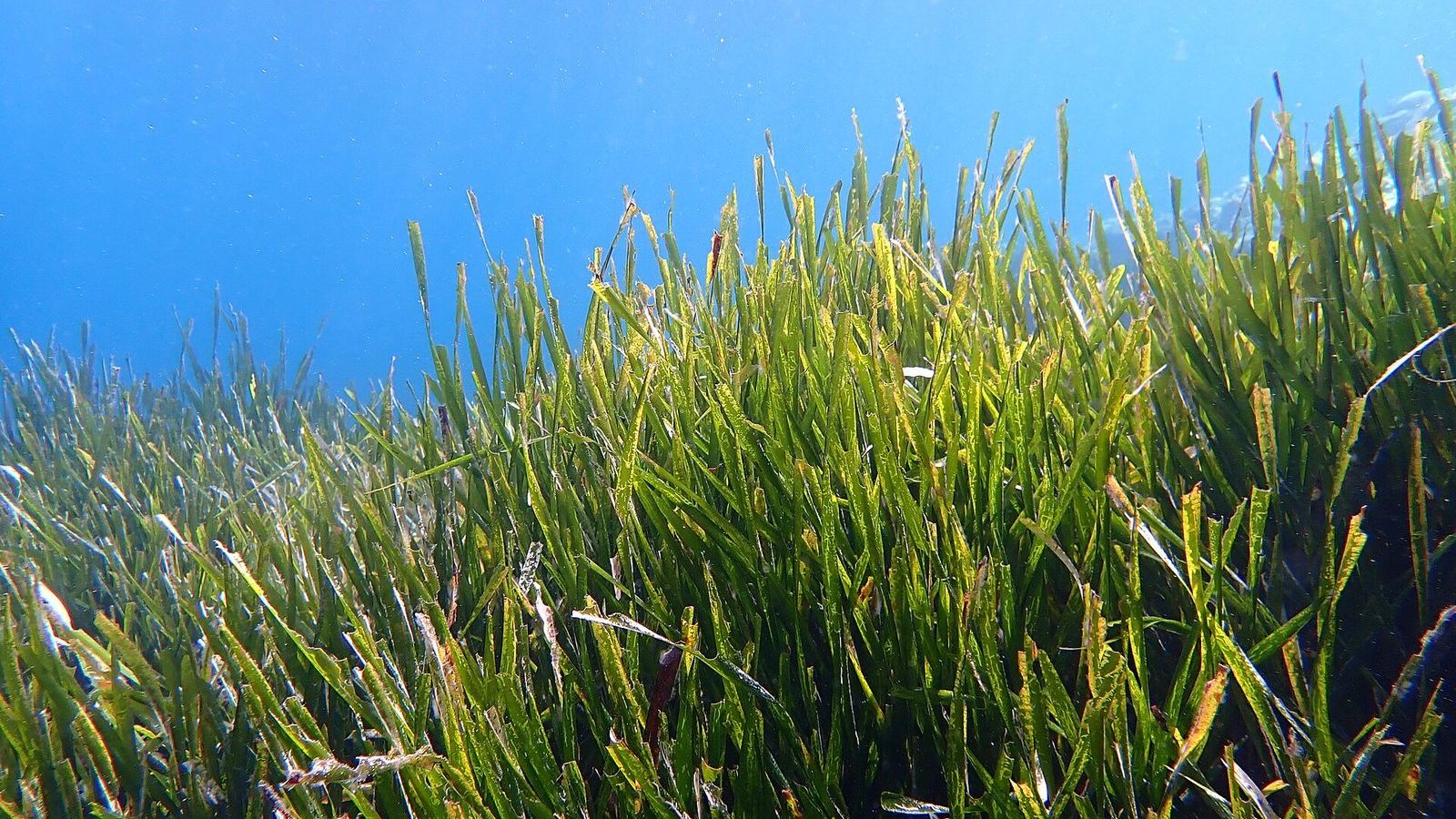
Seagrasses are monocots, relatives of the lilies and the pondweeds, whose ancestors lived on land and then in fresh water before colonizing the sea about 100 million years ago, during the Cretaceous period. They did it at least three times independently, which is why the roughly 72 species fall into four families. They kept the land-plant body: roots that anchor in sediment and take up nutrients from it, a horizontal stem called a rhizome, leaves with veins and air channels, and flowers. The flowers are small and green and the pollen is carried by water, as long threads or in slimy strands, and some species are pollinated by small crustaceans in the way that land plants are pollinated by insects.
Because they need sediment and sunlight, seagrasses grow on sand and mud in shallow, sheltered water, from the tropics to the Arctic, and they grow as meadows rather than as individuals. A meadow of Neptune grass (Posidonia oceanica) in the Mediterranean can be a single genetic individual spread by its rhizome. One clone off the island of Formentera was found to extend over about 15 km, and the estimate of its age, published in 2012 in a paper in PLoS One, runs into tens of thousands of years, which would make it one of the oldest living things known.
What a meadow does
The leaves slow the water. A current that enters a dense meadow loses much of its speed within a metre or two, and the particles it was carrying settle out among the shoots. The roots and rhizomes bind the sediment. The result is clearer water, a stable seabed, and a bank of fine material that builds up year after year. Green turtles (Chelonia mydas) and dugongs (Dugong dugon) graze the leaves directly, and a dugong eats about 30 kg of seagrass a day. Most of the production, though, goes into the detritus and the food web built on it, and into the animals that use the meadow as a nursery. Juvenile cod in the north, juvenile snappers and emperors in the tropics, cuttlefish, seahorses, and the young of many commercial shrimps spend their first months among the leaves.
The carbon
The part of the story that brought seagrasses into climate policy is what happens below the leaves. The sediment of a meadow is low in oxygen, so the dead roots and the trapped particles decay slowly, and the layer thickens by a millimetre or more a year. A compilation of measurements by James Fourqurean and colleagues, published in 2012 in Nature Geoscience, put the carbon stored in the top metre of seagrass sediment worldwide at between 4 and 8 billion tonnes, and under old Posidonia meadows the carbon-rich layer can be several metres deep and thousands of years old.
The burial rate is what makes the comparison with forests. Typical values for seagrass meadows are around 140 g of carbon per square metre per year, with a wide range, which is roughly ten times what the soil under a temperate forest accumulates. Take one square kilometre of meadow, a million square metres, at that rate, and it buries about 140 tonnes of carbon a year. Each tonne of carbon corresponds to 3.67 tonnes of carbon dioxide, so the square kilometre takes about 500 tonnes of carbon dioxide a year out of circulation and keeps it, as long as the meadow stands. Carlos Duarte, whose group did much of this work, set out the role of the vegetated coasts in the ocean's carbon budget in a 2017 review in Biogeosciences, and that paper is the research spotlight of Unit 7 of the masterclass.
How much has been lost
Seagrass is lost mostly to dirty water. Nutrients from rivers and sewage grow phytoplankton and the algae that coat the leaves, and the plants below are shaded out. Dredging, anchoring, and coastal building remove meadows directly, and heatwaves have killed large areas of Shark Bay in Western Australia and of the Mediterranean in recent years. A global compilation led by Michelle Waycott in 2009 estimated that about 29 per cent of the area known in the late nineteenth century had gone, and that the rate of loss had risen to about 7 per cent a year by the end of the twentieth century, comparable with the rates for coral reefs and tropical forests.
Nobody knows the total area well. Mapped meadows cover about 160,000 km², and estimates of the true extent, including the deep and turbid meadows that satellites cannot see, run up to several times that. The uncertainty is itself a finding: a habitat that buries carbon at ten times the rate of a forest has not been fully mapped on any continent.
When a meadow dies the carbon it buried does not stay buried. The sediment erodes, the stored material is exposed to oxygen, and decades or centuries of accumulation can be released in a few years. That is the reason seagrass restoration, which was long a niche activity of coastal ecologists, now appears in national climate plans.
Unit 7 of the Marine Biology Masterclass covers the rocky shore, mangroves, seagrass meadows, kelp forests, and salt marshes, with the carbon arithmetic above as a worked example and the Global Mangrove Watch as the week's tool. Unit 8 fits coastal carbon into the ocean's budget. The full outline is in the curriculum.