 Image: C. Van Dover (OAR/National Undersea Research Program (NURP); College of William & Mary) (public domain)
What lives on a hydrothermal vent, and what it eats
On 17 February 1977 the submersible Alvin descended to about 2,500 m on the Galápagos Rift, a seafloor spreading centre northeast of the islands, with two geologists and a pilot aboard. They were looking for warm water seeping from the young volcanic rock, which an instrument towed over the site the day before had detected. They found it, and around it they found a field of white clams the size of dinner plates, mussels, crabs, anemones, and pale fish, in water that was warm to the touch of the submersible's probe. The expedition had no biologist on board and almost no preservative, and the first specimens of a new kind of ecosystem went home in vodka.
Why nobody expected it
The deep seafloor was known to be sparsely populated, because almost all food there arrives as the slow rain of particles from the sunlit surface, and at 2,500 m very little arrives. A dense community of large animals in that setting made no sense if the Sun was the only source of energy. It made sense once the water chemistry came back. The vent fluid was loaded with hydrogen sulfide, and the clams' gills were packed with bacteria. The bacteria were oxidizing the sulfide with oxygen from the seawater and using the energy to build organic matter from dissolved carbon dioxide, and the animals were living on the bacteria. This is chemosynthesis, and it had been known in soil microbes since the 1880s, but no one had seen it feed a whole community.
Two years later, in 1979, another dive on the East Pacific Rise found the black smokers: chimneys of metal sulfide minerals jetting fluid at about 350 °C, black with precipitating particles. The hottest vent fluids measured since are a little above 400 °C. The water does not boil because at 2,500 m the pressure is about 250 atmospheres, and at that pressure seawater has to reach about 400 °C before it can boil. The critical point of seawater, above which liquid and vapour stop being different things, lies near 407 °C and 298 atmospheres, so the hottest vents sit just below it.
Where the energy comes from
Seawater sinks into cracks in the young crust at a spreading ridge, is heated by the magma a few kilometres down, and reacts with the rock. It loses its oxygen, magnesium, and sulfate, and gains hydrogen sulfide, iron, manganese, copper, zinc, hydrogen, and methane. It rises back to the seafloor hot and acidic and meets cold, oxygen-rich seawater. The mixture is out of chemical equilibrium, and anything that can catalyse the reaction between the sulfide and the oxygen gets the energy that is released.
Bacteria and archaea can. Oxidizing one mole of hydrogen sulfide to sulfate with oxygen releases about 800 kilojoules, which is in the range of the energy a cell gets from respiring a mole of glucose, and the microbes spend part of it on fixing carbon dioxide by the same Calvin cycle that plants use. The equation is the photosynthesis equation with sulfide in the place of water as the electron source and chemical energy in the place of light. Unit 9 of the masterclass sets out the energy yields of the main reactions, and Unit 14 applies them at the vent.
The worm with no gut
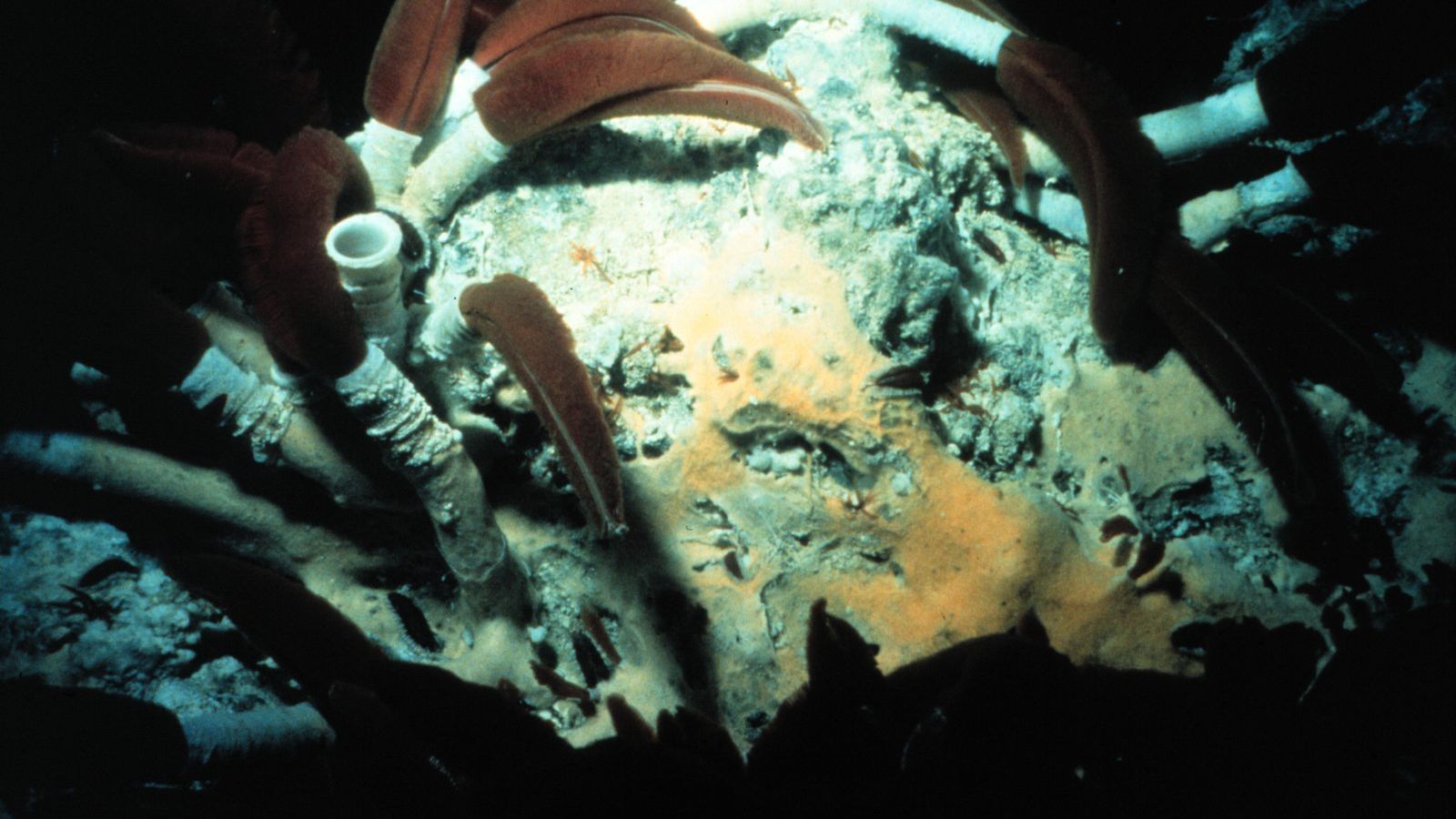
The animal that became the emblem of the vents was found on that same 1977 expedition and described in 1981. The giant tube worm (Riftia pachyptila) stands in a white tube up to 2 m long, with a red plume at the top, and it has no mouth, no gut, and no anus. Its body is filled instead with a spongy organ called the trophosome, which holds bacteria at densities of billions per gram of tissue. The plume is a gill. It takes up oxygen, carbon dioxide, and sulfide from the water around it, and the worm's blood carries all three to the trophosome. The blood is red because it contains haemoglobin, and the worm's haemoglobin is unusual in binding sulfide at a separate site from oxygen, so that it can carry both at once without the sulfide poisoning the animal's own respiration, which it would otherwise do in minutes.
Fed this way, the worm grows faster than almost any other marine invertebrate. Richard Lutz and colleagues reported in Nature in 1994 that tube worms colonizing a fresh lava flow on the East Pacific Rise grew by more than 85 cm in a year, reaching 1.5 m within two years of the eruption. The speed matters because vents are short-lived. A chimney can stop flowing within years or decades, and the animals that depend on it must have settled, grown, and reproduced before it does. Their larvae then have to find the next vent, which may be tens of kilometres along the ridge, and how they do it is one of the open questions of the field.
The rest of the community
Several hundred species are known only from vents. Besides the tube worms there are the vent mussels and clams with bacteria in their gills, the eyeless shrimp of the Mid-Atlantic Ridge that carry their bacteria on their mouthparts, the yeti crabs that farm bacteria on hairy arms, the Pompeii worm that lives on the sides of chimneys at temperatures above 50 °C, and the scaly-foot snail whose shell is armoured with iron sulfide. Each ridge system has its own set, and at the western Pacific vents the tube worms are replaced by snails and barnacles. Peter Girguis's group showed in 2012 that snails of two species sort themselves along a vent's chemical gradient according to which kind of bacterium they carry, a result that is the research spotlight of Unit 14.
Cold seeps are the slow cousins of vents: places where methane and sulfide leak from sediments on continental margins at the temperature of the surrounding water. Their communities run on the same chemistry at a lower rate, and their tube worms, in the genus Lamellibrachia, grow a few centimetres a year and live for more than 250 years.
The Woods Hole Oceanographic Institution, which operates Alvin, keeps an archive of vent expeditions for students at Dive and Discover, and the NOAA Ocean Exploration site has video from recent remotely operated vehicle dives on vents in the Pacific and the Atlantic. Unit 14 of the Marine Biology Masterclass covers the discovery, the chemistry, the symbioses, the seeps, and the anaerobic oxidation of methane, with the boiling point calculation above as a worked example. The full outline is in the curriculum.