 Image: Chisholm Lab (CC0)
How the ocean's most abundant photosynthetic cell went unnoticed until 1988
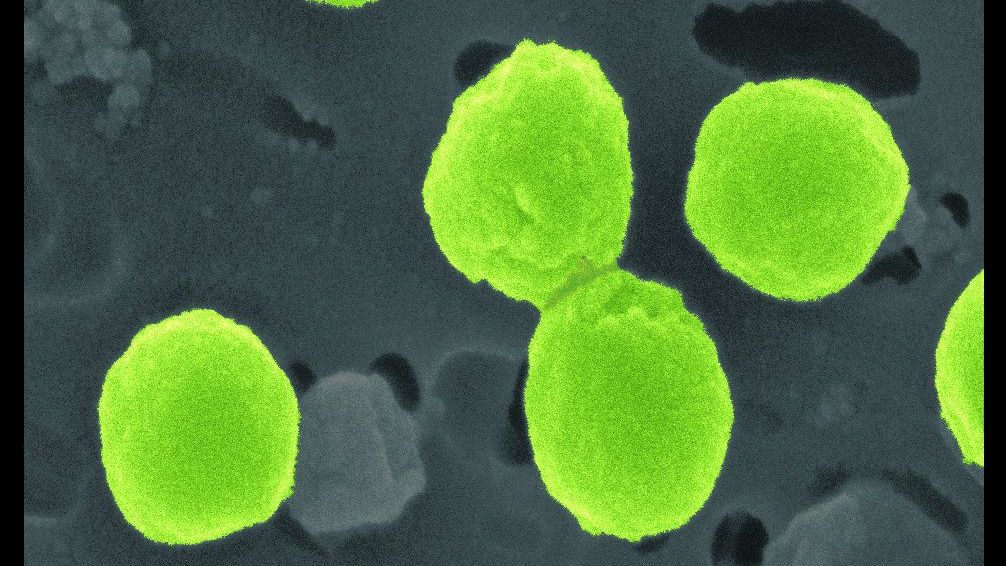
The most numerous photosynthetic organism on Earth was unknown until 1988. It is a cyanobacterium about 0.6 micrometres across, smaller than the wavelength of the green light it does not use, and it lives in the upper 200 m of the warm oceans at densities of up to 200,000 cells in a millilitre of water. Its name is Prochlorococcus. A century of marine biologists had looked at the water it lives in through microscopes and had not seen it, and the reasons they missed it say a lot about how the sea is studied.
Why the microscopes missed it
A light microscope resolves objects down to about 0.2 micrometres, so size alone was not the problem. The problem was contrast. Prochlorococcus is a featureless sphere with no cell wall structure a microscopist can recognize, it is so small that it is mistaken for debris or for a non-photosynthetic bacterium, and it fluoresces only faintly under the blue light used to pick out chlorophyll. Its pigments are also unusual: divinyl forms of chlorophyll a and b, rather than the ordinary chlorophyll a and the phycobilin proteins that give other cyanobacteria their colour and their bright orange fluorescence. The standard method for counting photosynthetic cells in seawater, epifluorescence microscopy, had been tuned to see those other cells. The nets used for plankton surveys, with meshes of 20 micrometres and more, let it through a thousand times over.
The instrument built for blood
A flow cytometer passes a stream of cells one at a time through a laser beam and records how each one scatters the light and what colour it fluoresces. The instruments were developed in the 1970s for medicine, to count and sort blood cells, and in the early 1980s Robert Olson at the Woods Hole Oceanographic Institution adapted one for seawater and took it to sea. Seawater is a difficult sample. The cells are far rarer than in blood, most of the particles are not alive, and the ship moves.
In 1985, on a cruise in the Sargasso Sea with Sallie Chisholm of the Massachusetts Institute of Technology, the instrument showed a population of particles below the Synechococcus signal that had chlorophyll fluorescence but almost no size and none of the orange phycobilin fluorescence. At first it looked like noise. It kept appearing, on cruise after cruise, always most abundant at the bottom of the lit layer, and it grew in culture only after years of trying. Chisholm, Olson, and their colleagues described the organism in Nature in 1988 under the heading "A novel free-living prochlorophyte abundant in the oceanic euphotic zone". The genus name came in 1992.
How many there are
Counting with a flow cytometer is quick, and within a few years there were thousands of measured profiles from every warm ocean. In 2013 Pedro Flombaum and colleagues fitted those counts to temperature and light and summed the result over the globe. Their estimate for Prochlorococcus was 2.9 × 10²⁷ cells, which is usually written as about three thousand trillion trillion, or about 3 × 10²⁷. For Synechococcus, its larger relative, they found 7 × 10²⁶. Together the two genera carry out about a quarter of all photosynthesis in the ocean, and the share of Prochlorococcus alone is roughly 4 billion tonnes of carbon fixed in a year.
Here is the arithmetic that a student in Unit 9 of the masterclass does. A single Prochlorococcus cell contains about 50 femtograms of carbon, that is 50 × 10⁻¹⁵ g. Multiply by 2.9 × 10²⁷ cells and the whole global population weighs about 1.5 × 10¹⁴ g of carbon, or 150 million tonnes. That is a small number for an organism that fixes billions of tonnes a year, and the ratio between the two tells you that the population turns over roughly every two weeks. Everything it makes is eaten, by grazers and by viruses, almost as fast as it is made.
Not one organism
The name covers a federation rather than a species. Cells taken from the surface, where the light is strong, differ genetically from cells taken from 100 m down, where it is a hundred times dimmer, and the two groups, called the high-light and low-light ecotypes, have different pigment ratios, different light responses, and different genes. Within each ecotype there are hundreds of strains, each with its own small set of extra genes for a particular nutrient or stress. The genome of the strain MED4 holds about 1,700 genes, one of the smallest known for any organism that makes its own food from light, and the genus survives on that economy by sharing the work out across its many strains. Chisholm's group set the idea out in a 2015 review, which is the research spotlight of Unit 9; the free copy is in MIT's repository.
What it tells you about the sea
The lesson students take from the story is usually about instruments, and that is right as far as it goes. Prochlorococcus was found because a new way of looking at seawater arrived, and most of the ocean's microbial diversity has been found the same way since, by flow cytometry, by DNA sequencing, by cameras that photograph plankton in place. The second lesson is about scale. A cell at the limit of visibility, with the smallest genome of its kind, is responsible for a measurable part of the oxygen you breathe, and nobody had seen it before a year in which many of today's marine biologists were already at school.
Unit 9 of the Marine Biology Masterclass treats the microbial ocean by numbers, the microbial loop, and the nutrient cycles, with the discovery cruise as an excursion. Unit 3 introduces Prochlorococcus among the phytoplankton groups. The full outline is in the curriculum.