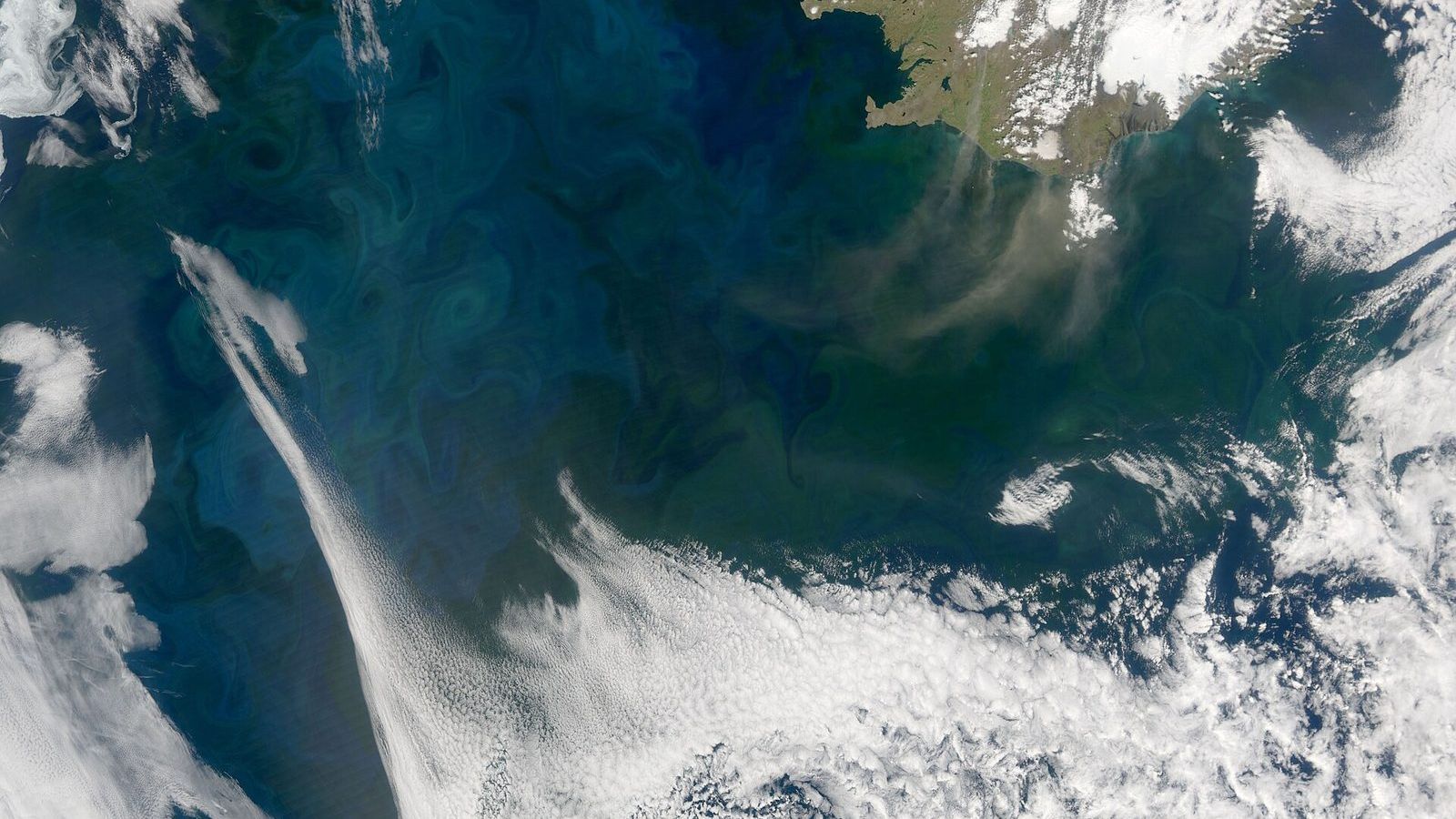
 Image: Norman Kuring (public domain)
Why the North Atlantic turns green every spring
In early April the satellite images of the North Atlantic start to change. Off Portugal and Spain the water takes on a faint green. By May the colour has spread to the latitude of Ireland, and by June it has reached Iceland and the Norwegian Sea, where it burns bright for a few weeks and then fades. The colour is chlorophyll, and the event is the largest seasonal bloom of phytoplankton on the planet. Its cause was explained in 1953, and the explanation has been argued about ever since.
What the satellites see
Ocean-colour satellites measure the light leaving the sea surface in several wavelengths and convert it into a chlorophyll concentration. In the winter North Atlantic the surface holds about 0.1 to 0.3 milligrams of chlorophyll per cubic metre. At the height of the bloom the figure rises to 2, 5, or even 10 milligrams per cubic metre in patches. The growth is exponential while it lasts. A rise from 0.3 to 3 milligrams in 20 days corresponds to a net growth rate of about 0.115 per day, or a doubling of the population every six days, after the grazers have eaten their share.
The bloom moves north with the season because it depends on light and on the structure of the water, and both change later at higher latitudes. The mechanism was set out by the Norwegian oceanographer Harald Sverdrup, in a paper of eight pages.
Sverdrup's critical depth
In winter the North Atlantic is stormy and the surface is cold. Cooling and wind mix the upper water into a layer several hundred metres thick, in places more than 400 metres. A phytoplankton cell in that layer is carried up and down through the whole of it. Near the surface it photosynthesizes; deeper down, in the dark, it only respires. Whether the population can grow depends on the average over the depth it is stirred through.
Sverdrup's argument, published in the Journal du Conseil in 1953 under the title On Conditions for the Vernal Blooming of Phytoplankton, defines a critical depth: the depth above which the total photosynthesis of the layer equals its total respiration. If the mixed layer is deeper than the critical depth, the cells spend too long in the dark and the population cannot grow. If the mixed layer is shallower, net growth is possible and a bloom can begin. In spring the sun rises higher, the surface warms, the storms ease, and the mixed layer shoals rapidly from hundreds of metres to a few tens of metres. The moment it crosses the critical depth, the bloom starts. Because the warming and calming spread northwards with the season, so does the bloom.
The critical depth can be estimated from two numbers: the attenuation coefficient of the water and the light level at which a cell's photosynthesis just balances its respiration. With a winter attenuation coefficient of 0.1 per metre and a compensation light level of about 1 per cent of the surface value, the critical depth comes out at a few tens of metres in March and deepens as the days lengthen. Sverdrup tested the idea with data from Weather Ship M, stationed at 66° N in the Norwegian Sea in 1949, and found that the bloom began in the weeks when the mixed layer became shallower than his calculated critical depth.
What ends it
A bloom is a loan taken out against the winter's nutrients. The deep mixing that keeps cells in the dark also brings nitrate, phosphate, and silicate up from below, so that the surface water in March holds more nutrients than at any other time of year. The bloom consumes them. The diatoms, which dominate the early bloom, run out of silicate first and sink; the smaller flagellates that follow run out of nitrate. Grazing copepods, which have been waking from their winter rest in deep water, multiply a few weeks behind the phytoplankton and eat much of what is left. By July the surface of the North Atlantic is warm, stratified, clear, and poor in nutrients, and stays that way until the autumn storms begin to mix it again.
Where the sinking cells end up is the subject of the ocean's carbon pump: a share of the bloom's carbon reaches the deep sea and stays there for centuries. The North Atlantic bloom is one of the largest contributors to that export anywhere in the ocean.
The argument since 2010
Sverdrup's hypothesis fits the spring data, but a closer look at the winter data raised a problem. Floats and ships that sampled the North Atlantic in December and January found that the phytoplankton population, counted as cells rather than as concentration, was already growing while the mixed layer was still hundreds of metres deep, long before the critical depth criterion was met. Michael Behrenfeld of Oregon State University pointed this out in a paper of 2010 whose title announced its intent, Abandoning Sverdrup's Critical Depth Hypothesis on phytoplankton blooms.
His alternative, the dilution-recoupling hypothesis, turns the question around. Growth of phytoplankton is the difference between division and loss, and the main loss is grazing. When winter mixing deepens the layer, it dilutes both the phytoplankton and the zooplankton that eat them. A diluted predator finds its prey less often. Grazing falls faster than growth, and the phytoplankton begin to gain ground in the dark of midwinter, slowly, as a thin population spread through a deep layer. In spring, when the layer shoals and the light improves, the accumulated population becomes concentrated and visible from space. The spring bloom, in this view, is the end of a process that began in December.
Testing the two ideas needed better data than either side had, and from 2015 to 2018 the North Atlantic Aerosols and Marine Ecosystems Study, NAAMES, sent a research ship and an aircraft to the same region in four different seasons to measure the growth and loss rates directly. The overview paper of 2019 lays out the campaign. The results support the view that winter growth is real and that grazing controls much of the seasonal cycle, without making the mixed-layer shoaling irrelevant: the spring acceleration is still tied to the light, and the two mechanisms are better seen as phases of one annual cycle than as rivals.
What a student takes from it
The spring bloom is a good first encounter with how oceanography works. A simple physical argument, light against mixing, explains the broad pattern. A closer look at the data, with better instruments, finds a second process underneath. The textbook answer and the current answer are both right about something, and a student who can state both, with the evidence for each, understands the North Atlantic better than one who has memorized either.
Unit 3 of the Marine Biology Masterclass works through the critical depth calculation with real numbers, follows the bloom in satellite data, and presents the dilution-recoupling idea with its evidence. The outline of the program is in the curriculum, and NASA Worldview, one of the free tools recommended in the program, lets anyone watch this year's bloom appear.